
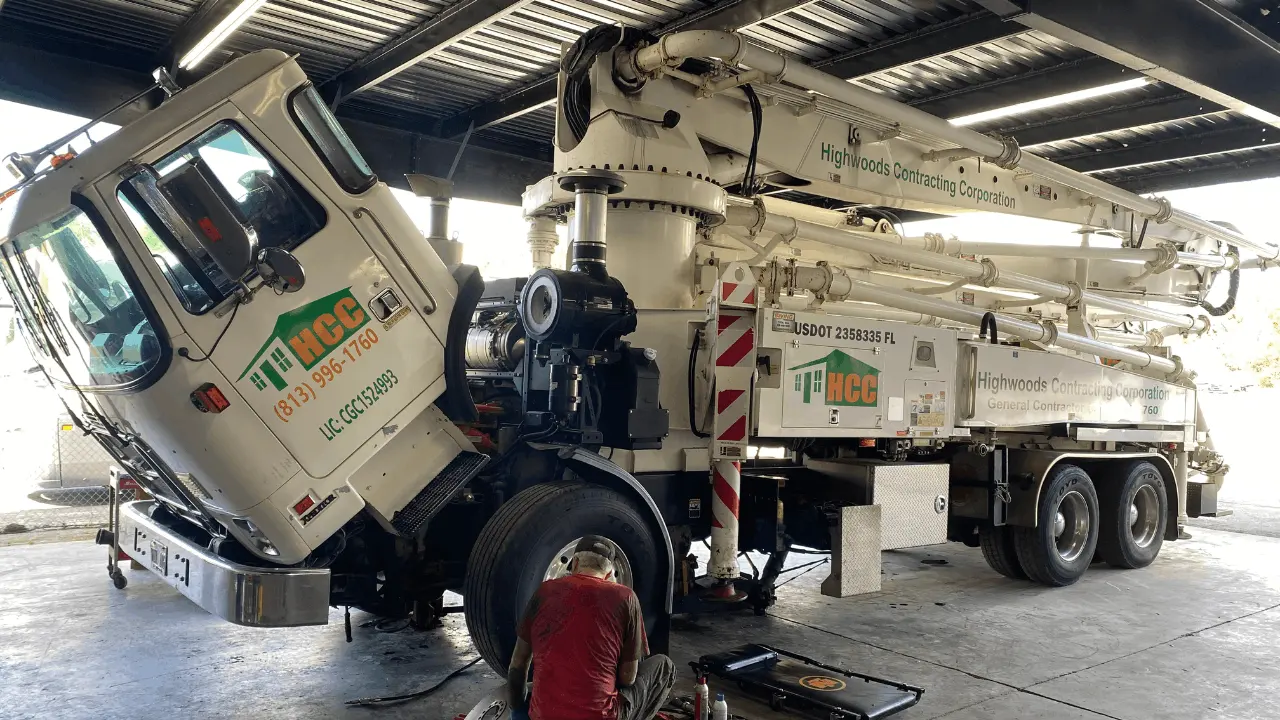
Growth along the Suncoast Parkway and the I-75 corridor has kept construction trucks busy across Hernando and Pasco counties, and those trucks work harder than almost anything else on the road. They run loaded, run slow, idle for hours and drive over debris that would ruin a highway tractor’s tires. RDI Power keeps construction fleets running from our Brooksville shop and on-site at the job.
What a construction fleet runs
- Tri-axle and tandem dump trucks
- Concrete mixer trucks
- Flatbeds and stake bodies
- Crew trucks: Ford Super Duty, Ram and GM heavy duty pickups and cab-and-chassis trucks
- Service, fuel and lube trucks
- Water trucks for dust control
- Tractors pulling lowboys, tilt trailers and equipment trailers
Under the hood that means Cummins, Caterpillar, Detroit, Power Stroke and Duramax diesels, on chassis from Freightliner, Peterbilt, Kenworth, Mack, International and Western Star.
Failure points on construction trucks
Aftertreatment
Site work is about as hard a duty cycle as a modern emissions system ever sees. Creeping around a pad, waiting in a loader line and idling through lunch keep exhaust temperatures low, so particulate filters load up and regenerations get cut short. EGR valves and coolers foul under the same conditions. A truck that keeps derating usually has a root cause upstream of the filter, and finding it is what our exhaust and emissions diagnosis is for.
Brakes, springs and frames
Loaded starts and stops on rough ground wear brakes fast and work springs, hangers, U-bolts and frame rails hard. Overloading cracks frames and breaks spring leaves. Brake adjustment and linings get checked at every PM. See brake systems.
Tires
Rebar, concrete chunks, screws and demolition debris are on every site. Sidewall cuts and punctures are routine, and a truck running a damaged tire loaded is a blowout waiting to happen. See tires.
PTO and hydraulic drive
Dump hoists and mixer drums depend on PTOs and hydraulic pumps driven by the truck. A leaking line or a PTO problem takes the truck out of work even when the engine is fine.
Cooling
A truck working hard at walking speed gets little air through its radiator, and site dust coats the radiator cores that have to shed the heat. Add a Florida summer afternoon and a slipping fan clutch, and the temperature gauge climbs. Clean cores, a healthy fan drive and fresh coolant keep a site truck out of the overheating cycle that ends in head gasket work.
Electrical add-ons
Beacons, work lights, backup alarms and body controls are often added after the truck leaves the factory. Chafed harnesses and bad grounds behind those add-ons cause intermittent faults that are easy to misdiagnose.
How RDI Fleet keeps a construction fleet working
An RDI Fleet plan for a contractor looks different from a highway fleet’s:
- Hour-based PM for trucks that idle on site, mileage-based PM for trucks that mostly haul
- On-site service at the job or the yard through mobile diesel repair, so PM and many repairs happen without pulling a truck off the project
- Annual DOT inspections for trucks and trailers, lined up with PM. See DOT inspections
- Digital inspection reports with photos for each unit, which help when deciding which truck to repair and which to replace
- Priority scheduling when a phase deadline or a pour is on the line
Why downtime matters on a job
Construction runs on sequence. A dump truck that does not show up stalls the loader, the grading crew and the inspection scheduled after them. A mixer that breaks down loaded has a time limit before the concrete becomes the bigger problem. A lowboy that cannot move equipment leaves a machine and its operator idle at the wrong site. Each truck failure breaks the sequence, and the cost lands on every trade behind it.
Keep the job moving
Tell us what you run and where your jobs are. We will build maintenance around your schedule and come to the site when a truck goes down mid-project.