
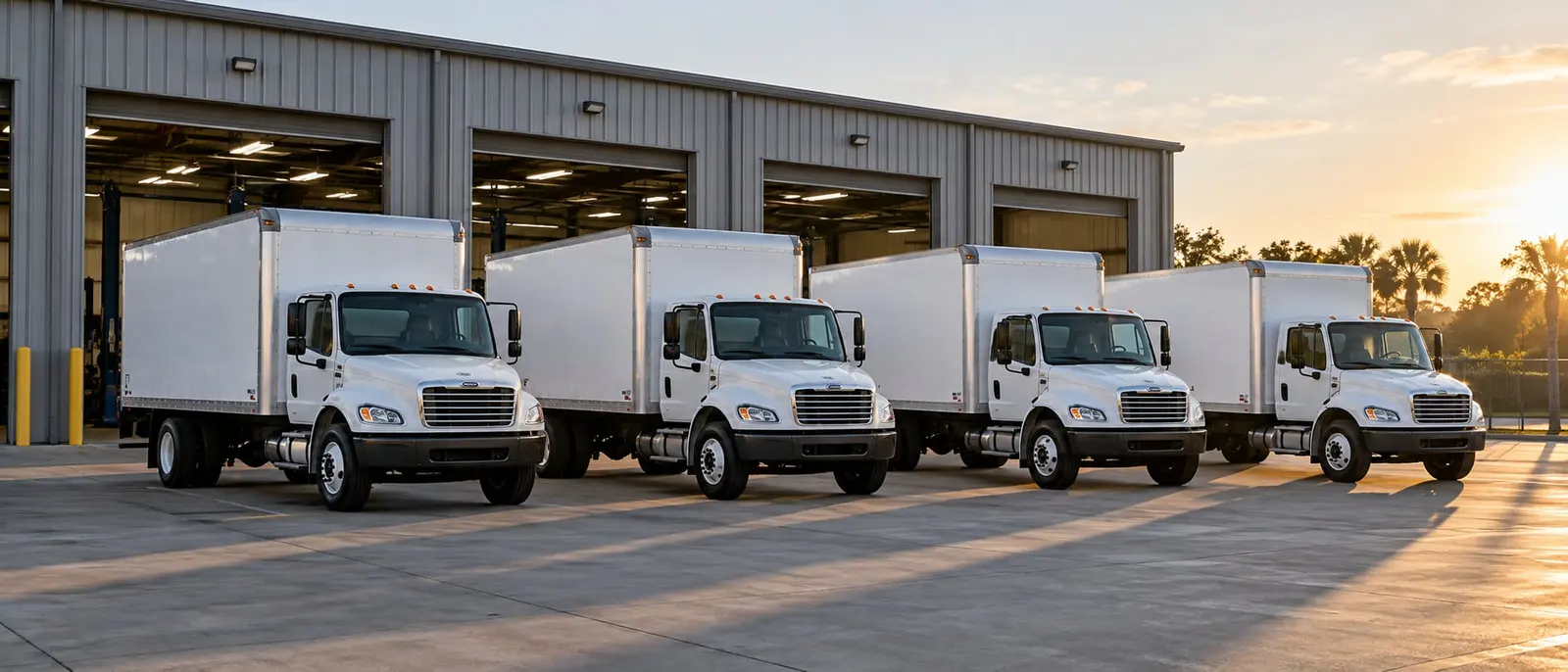
Ryan Bethell started RDI Power as a mobile unit, keeping fleets running between Brooksville and Tampa before the shop on Donto Way ever opened. RDI Fleet is that same work organized into a program: a maintenance plan written for your operation, preventive maintenance on a schedule you can see, and repairs diagnosed to the root cause and done right the first time, in our Brooksville bays or at your yard. It covers light, medium and heavy duty trucks, trailers and buses across Hernando, Pasco and Citrus counties, with on-site service across Central Florida up to about 100 miles out.
What RDI Fleet is
RDI Fleet is the name of RDI Power’s fleet program, not a separate shop. Same building, same technicians, same phone number. What changes when you become a fleet account is how the work is organized: your units are on a schedule, your records live in a single place, your trucks get priority in the shop, and you have a single point of contact who knows the trucks, their histories and the way your operation runs.
The point is uptime. A fleet needs more than a shop that reacts well to breakdowns. It needs a partner that sees them coming, diagnoses every concern properly, fixes the root cause once, and keeps a written record that tells you what each truck needs next.
A plan built around your operation
Fleets do not run the same way. A contractor with Super Duty pickups and a few dump trucks has different needs than a carrier running tractors and trailers on I-75 every day, and both differ from a school or church running buses on a calendar. We build the plan around:
- Your operation. Duty cycle, routes, loads, idle time, and the days a truck can come out of service without hurting the schedule.
- Your budget. What needs doing now, what can be planned for next quarter, and what to watch. You get a straight answer on each so spending is planned instead of reactive.
- Your fleet size. A handful of work trucks or a large mixed fleet, the plan scales to the units you actually run.
- Your vehicle classes. Light duty pickups and vans (Ford, Ram, GM, Nissan Titan XD, Sprinter), medium duty work trucks, heavy duty tractors and vocational trucks (Freightliner, Peterbilt, Kenworth, Mack, Volvo, International, Western Star), trailers and buses. Each class gets intervals that fit it, not a single schedule stretched across all of them.
Scheduled preventive maintenance
PM intervals are set by miles, engine hours or calendar time, whichever matches how the truck works. A highway tractor piles up miles. A dump truck or a bucket truck that idles at a job site piles up hours with little mileage to show for it. We start from the manufacturer’s recommendations and adjust for your duty cycle, Florida heat and what the inspection history shows.
A typical diesel PM on an RDI Fleet unit includes:
- Engine oil and filter, with a look at what comes out
- Fuel filters and water separator service
- Air filter inspection or replacement, plus an intake check for leaks
- Coolant condition and level, belts, hoses and radiator
- Brake inspection with lining measurements and, on air brake trucks, adjustment and air leak checks
- Tire tread depth, pressure, wear pattern and damage
- Steering and suspension components and chassis lube points
- Lights, wipers and horn
- Batteries, charging and starting system
- Exhaust aftertreatment: DPF, DEF system and EGR concerns
- A scan for stored and pending fault codes
- A leak check on the engine, transmission, differentials, power steering and hydraulics
Intervals by class
- Light duty pickups and vans. Usually mileage-based, following the manufacturer’s schedule or oil life monitor, and shortened for heavy towing, idle time and short trips.
- Medium duty vocational trucks. Often set on engine hours as much as miles, with PTO time counted, because a dump, bucket or service truck can run all day without going anywhere.
- Heavy duty tractors. Mostly mileage-based, with highway duty supporting longer intervals than stop-and-go work.
- Trailers. Brakes, bearings, lights and tires checked on their own schedule, timed with the tractor’s visit where the pair runs together.
- Buses. Planned around the calendar, so the work lands before the school year, the busy tour season or the weekly service schedule.
Every finding goes on the digital inspection with photos, so a worn part becomes a planned repair instead of a roadside call. Our preventive maintenance page covers the service items in more detail.
DOT inspections
Trucks, trailers and buses that fall under FMCSA rules need an annual inspection, with the documentation on the vehicle. On an RDI Fleet account, each annual comes due on the same schedule as that unit’s PM, so the truck is in once and leaves with both done. Anything that does not pass is photographed, written up and, once you approve it, repaired in the same shop. Our DOT inspections page explains what the inspection covers and the paperwork you keep.
Priority scheduling for fleet accounts
A fleet truck waiting in a shop line is a route not run. Fleet accounts get priority in the shop schedule, and PM is booked ahead around your slow days, so trucks come out of service when it costs you least. When something unplanned happens, your point of contact already knows the truck and its history, which shortens the path to a real diagnosis.
In the shop or at your yard
RDI started on the road, and mobile service is still part of how the fleet program works. Our technicians come to fleet yards and job sites with diagnostic tools and the equipment to repair on-site, so PM, inspections, diagnostics and many repairs happen where your trucks park. Work that needs a bay, such as major engine or transmission jobs, comes to Brooksville, and we plan that move with you.
Within about 25 miles of the shop you can choose either. Beyond that, out to about 100 miles across Central Florida, we come to you. See mobile diesel repair for how on-site service works.
Digital inspections and reporting
Every RDI Fleet job comes with a digital vehicle inspection: photos and technician notes on what we found, what we did and what we recommend. You see the cracked hose or the worn brake lining the way the technician saw it, before you approve the work.
Over time those inspections become your fleet records:
- A service history for each unit
- Findings sorted into what needs attention now and what can be planned
- Upcoming PM and inspection due dates
- Plain-language notes you can hand to a driver, a manager or an auditor
Warranty and roadside
Fleet repairs are backed by the RDI Fleet warranty: 2 years / 24,000 miles. Fleet accounts also get 24/7 roadside assistance, so a breakdown outside shop hours goes to people who already have that truck’s records.
Industries we serve
RDI Fleet works for operations whose trucks earn their keep at job sites, pits, farms and yards as much as on the highway:
- Agriculture: farm trucks, cattle haulers and stock trailers
- Construction: dump trucks, mixers, crew trucks and equipment haulers
- Mining: limerock and aggregate haulers and pit support trucks
- Transportation: carriers, owner-operators and delivery fleets
- Emergency services: public works, utility and storm response fleets
- First responder vehicles: ambulances, fire apparatus and police trucks
- Forestry: log trucks, chip haulers and lowboys
- Drilling: rig carrier trucks and water trucks
- Roads: paving, sweeping and road maintenance fleets
- Lifting: crane, boom and bucket trucks
How onboarding works
Getting a fleet onto a plan is straightforward work. Here is what RDI does:
- Intro call. We talk through your operation: how many units, which classes, where they park, how they are used, what keeps breaking and how maintenance is handled today.
- Fleet walk-around and inventory. We look at the trucks, at your yard or ours, and build an inventory by unit: VIN, engine, mileage or hours, and condition. Units with open problems get flagged first.
- Setting PM intervals. Using that inventory, the manufacturer’s schedules and your duty cycle, we set intervals for each class and line up annual DOT inspection dates.
- A shared schedule. You get a schedule of what is due and when, planned around your slow days. Then the work starts, and every visit is documented.
Build a fleet plan
Start with a call to (352) 433-3800 or a service request. It helps to have a unit list ready: year, make, model, engine, mileage or hours, and any trucks with open problems. If you do not have a clean list, that is fine. Building it is part of the walk-around. Tell us how your trucks work, and we will show you what a plan for them looks like.