
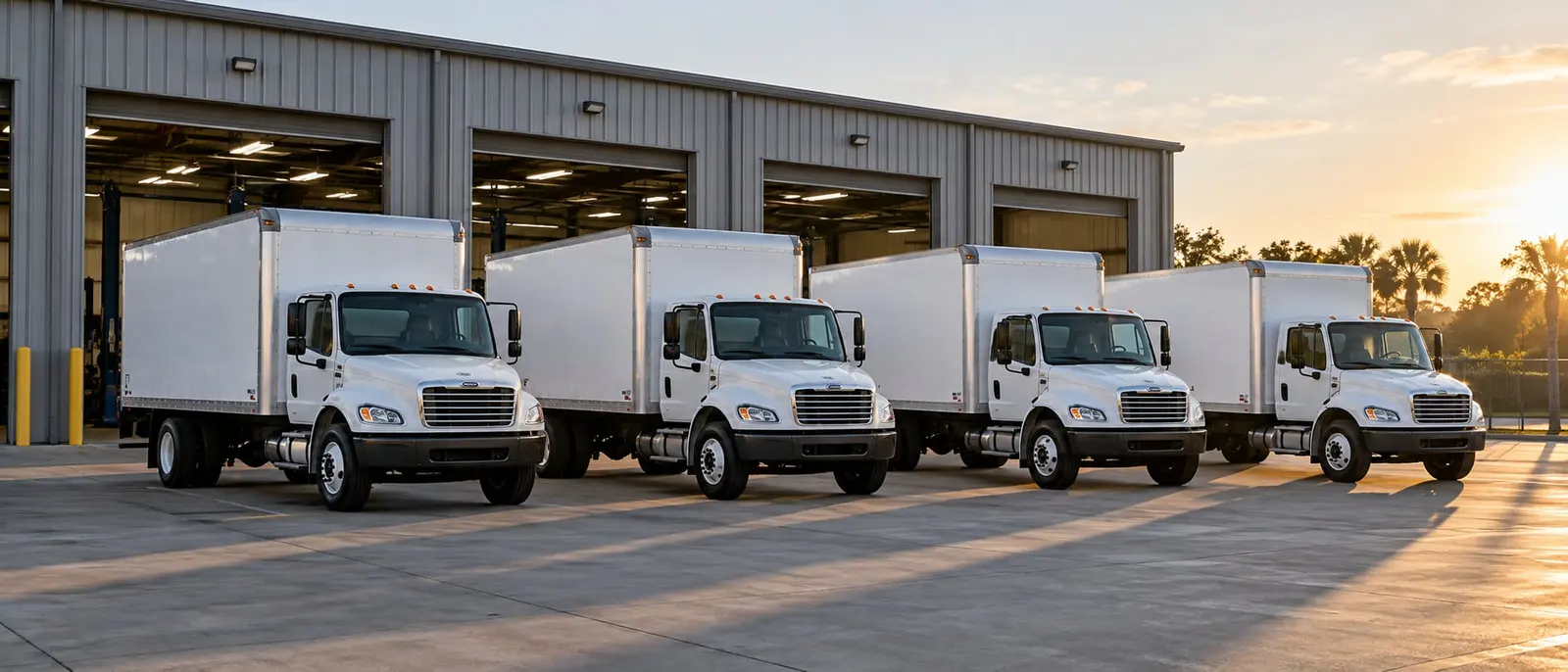
Dunnellon was built on freight. The city grew out of an 1889 phosphate boom, the first in Florida, and its last mine closed by the 1960s. Freight never left, though. A short line railroad still runs a terminal here, the county runs an airport with an industrial park beside it, and US 41 carries a truck share near 30%. For operators whose trucks work any of those, our fleet program, RDI Fleet, brings planned maintenance to the yard: technicians come out from the Brooksville shop on a schedule set around your operation, service the units where they park and send a photo record of every visit.
Rail, runway and road: the Dunnellon freight picture
The Florida Northern Railroad operates a Dunnellon Terminal offering transloading and car storage, and its line from Newberry to Red Level runs through town to the Crystal River Energy Complex. Dunnellon/Marion County Airport, which the county describes as about 800 acres split between an airport and an industrial park, sits along CR 484 just outside the city. And US 41, running 24 miles north to Williston and 18 miles south to Inverness, carries about 6,493 trucks a day near Dunnellon in FDOT’s 2025 count, with CR 40, CR 336 and CR 484 all feeding into it in town.
Those are 3 different kinds of truck work in one small city, and they wear a diesel in 3 different ways. A plan that treats every unit the same will service some trucks too often and others not nearly enough, which is why each RDI Fleet unit gets its own interval and its own checklist emphasis.
Maintenance for trucks serving the Dunnellon terminal and industrial park
If your trucks move freight to and from a transload or an industrial park, much of their day is short loaded runs and waiting: idling in a queue, creeping through a yard, then a heavy pull back onto the road. That duty cycle adds engine hours far faster than miles. It is hard on brakes and the air system, and it keeps exhaust temperatures low enough that the DPF depends on active regenerations.
For those units, an RDI Fleet plan sets intervals by hours, measures brake linings and checks for air leaks at every visit, and pulls regeneration history from the engine computer so a filter that is loading up gets attention before it shuts the truck down. Our transportation page covers the carriers and delivery fleets we work with.
Rural miles on US 41, CR 40 and CR 336 from Dunnellon
Trucks that run long rural routes out of Dunnellon, north toward Williston and Levy County or south toward Inverness, see the opposite pattern: steady highway miles, few stops and long stretches far from help. Their intervals are mileage-based, and the visit centers on what fails on the open road:
- Tires and wheel ends. Tread, pressure, wear patterns, bearings and seals.
- Cooling. Hoses, belts, radiator condition and coolant, because a cooling failure 20 miles from town is a long tow.
- Brakes. Linings, drums or rotors, and adjustment on air-braked units.
- Charging. Batteries and alternators tested under load.
Yard visits from Brooksville for Dunnellon operators
We plan visits around your operation, on the days and hours your trucks are parked. A technician can service several units in one visit, trailers included, and each gets the same thorough checklist used in our shop. Annual federal inspections are folded into PM for the units that need them. Repairs that need a lift or a teardown, such as major engine or transmission work, are booked into the Brooksville shop, where fleet accounts get priority.
Fleet warranty and roadside on Dunnellon’s county roads
Each visit produces a digital vehicle inspection with photos, technician notes and findings sorted by urgency, and over time those reports become a full service history for every unit. Repairs on an RDI Fleet account carry a 2-year, 24,000-mile warranty. When a fleet truck stops on US 41 at night or on CR 40 on a weekend, fleet customers have roadside help 24/7.
For a single breakdown, see mobile diesel repair in Dunnellon. North on US 41, our Williston fleet maintenance page covers Levy County operators, and RDI Fleet maintenance explains the program end to end. Call (352) 433-3800 with your unit list and a description of how the trucks work.