
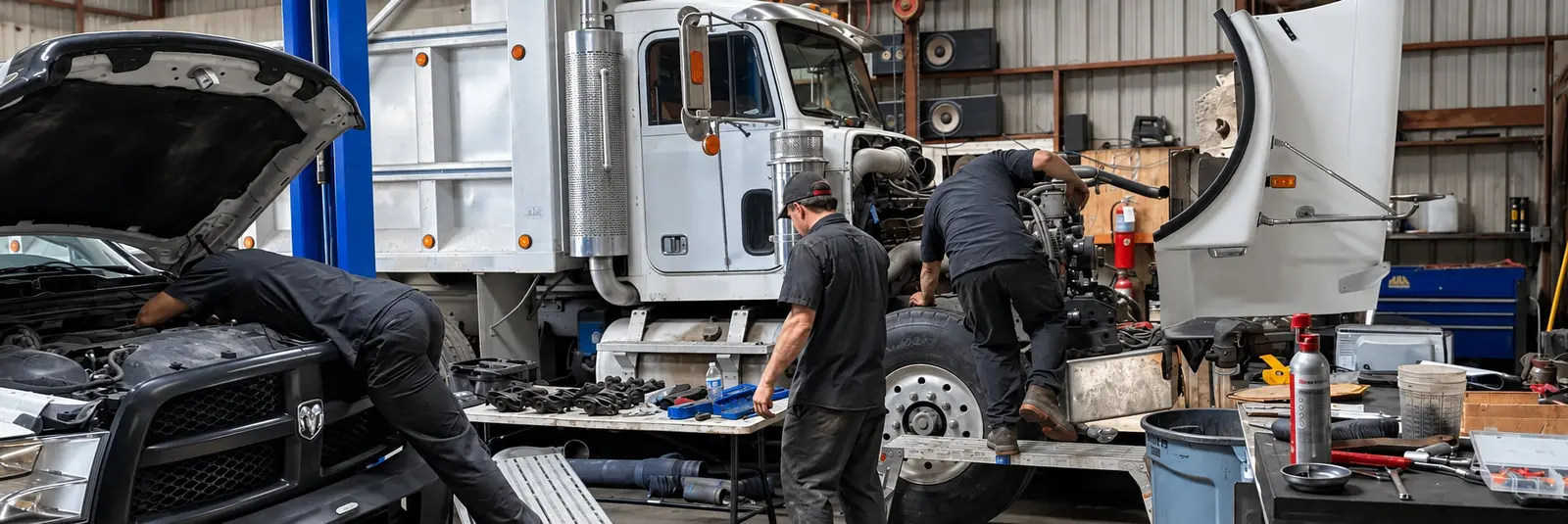
Volvo trucks tend to arrive with long-haul miles and tight schedules. RDI Power services VNL, VNR and VHD trucks at our Brooksville shop and on site across Central Florida, with diagnosis built around Volvo’s own engines and its I-Shift transmission.
What Volvo puts on the road
| Model | Built for |
|---|---|
| VNL | Long-haul sleepers and day cabs |
| VNR | Regional and local delivery |
| VHD | Vocational work: dump, mixer, roll-off |
| VNX | Heavy haul |
| VAH | Car hauling |
D11, D13 and D16 engines
Most Volvos run Volvo power. The D13 is the workhorse, the D11 suits lighter regional specs, and the D16 goes into heavy-haul trucks. Some D13s are the turbo compound version, which adds a turbine that feeds recovered exhaust energy back to the crankshaft. A Cummins X15 is available in some models too.
Every current Volvo engine combines EGR with a DPF and SCR. When a Volvo loses power or sets emissions faults, we look at the whole air path: turbo actuator response, EGR valve and cooler, charge air cooler leaks, NOx sensor agreement and DEF dosing. A turbo compound engine adds its own unit to that list. More on boost problems on our turbocharger repair page.
Overhead and injector service
The D11 and D13 use overhead camshafts that drive electronic unit injectors, so valve and injector adjustment at the intervals Volvo specifies is part of keeping them healthy. We compare cylinder contribution data before condemning an injector, because an adjustment problem can look like a failed part.
I-Shift troubleshooting
The I-Shift is a 12-speed automated manual that moves its gears with compressed air, and vocational versions add crawler gears for job site work. Because the shift actuators run on air, moisture and oil carried over from a tired air dryer or a worn compressor can cause sluggish or missed shifts. Our order of work is fault history, air quality and pressure, clutch wear, then calibration. Replacing a transmission control unit without checking the air first is how money gets wasted.
Aftertreatment and regen
A VNL running steady highway miles usually regenerates on its own. Trouble shows up as regens that come too often, regens that never finish, or a derate. The cause is usually upstream: an injector, an EGR fault or a boost leak producing extra soot, or a sensor misreading the filter. We find that cause, then decide whether the DPF needs cleaning. Our exhaust, DPF and EGR page goes through the system.
Wheel ends, steering and tires
Long highway miles wear steer tires, kingpins and wheel bearings. Uneven steer tire wear on a Volvo tractor is usually an alignment or worn-component problem, not a tire problem. We inspect wheel end play and steering linkage, then align with our truck alignment equipment so new tires last.
How we diagnose a Volvo
We pull fault history from the engine, aftertreatment, I-Shift and ABS controllers, then road test the truck loaded when the complaint only appears on a grade or at highway speed. Charge air leak tests, air system checks and sensor comparisons confirm the cause, and you approve the repair after seeing the photos in our digital inspection.
What to note before you call
Volvo’s driver display shows fault messages in plain text. A photo of the message, the mileage and what the truck was doing when it appeared (climbing, idling, regenerating) saves diagnostic time. Note whether the engine derated and whether the warning cleared after a restart.
When a Volvo should come in
- I-Shift fault messages, missed shifts or a refusal to engage
- DPF or emissions warnings that return after a regen
- A turbo or compound unit that has gotten louder
- Air pressure that builds slowly, or an air dryer that purges constantly
- Steer tires wearing unevenly
Send us the VIN and the fault message, and we will tell you whether the truck should come to Brooksville or whether a mobile technician can start the diagnosis where it is parked.