
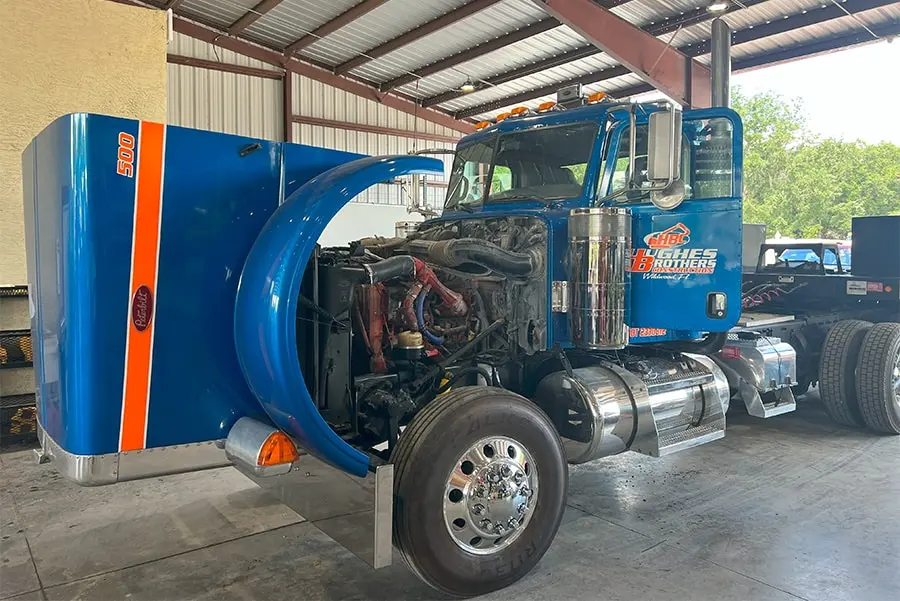
Peterbilts stay in service a long time, so a Brooksville shop sees everything from a late-model 579 with a PACCAR MX-13 and an automated transmission to a 379 that has run its original Caterpillar for decades. The first job on any Peterbilt is knowing exactly which engine and controls are on that truck, because the diagnosis changes with it.
Start with the engine under the hood
PACCAR MX-11 and MX-13
PACCAR’s own heavy-duty engines, developed from DAF designs. Both use EGR, a DPF and SCR with DEF, so most of their complaints live on the air and aftertreatment side: EGR components, NOx and pressure sensors, doser problems and soot loading. We check what is making the soot before we clean or replace anything downstream.
PACCAR PX-7 and PX-9
These are Cummins engines built for PACCAR: the PX-7 is based on the B6.7 and the PX-9 on the L9. Parts, procedures and failure patterns line up with the Cummins versions, which matters on medium-duty Peterbilts like the 536, 537 and 548. Our Cummins service page covers that family.
Cummins X15
Offered across the heavy lineup, including the 389, 567 and 579. Same aftertreatment chain as the MX engines, with Cummins calibrations and service procedures.
Caterpillar in older Peterbilts
Caterpillar left the on-highway truck engine market around the 2010 emissions change, so any Cat-powered Peterbilt is an older truck, usually a 3406 or C15. Those engines are still worth keeping alive, and RDI is Caterpillar certified. Read about our Caterpillar engine repair and the 3406 PEEC problems we run into.
Transmissions and clutches
Peterbilts come with Eaton Fuller manuals, Eaton automated transmissions or the PACCAR TX-12 automated manual. On manual trucks, clutch free play and the clutch brake need regular adjustment; a clutch brake that no longer stops the countershaft is why a driver grinds into gear at a stop. We cover that work on our clutch repair page.
Medium-duty Peterbilts
The 536, 537 and 548 work as box trucks, wreckers, dump trucks and service bodies, mostly in stop-and-go local work. Allison automatics are common in this class, and brakes may be hydraulic or air depending on how the truck was spec’d. Short routes and long idle times are hard on the DPF, so we look at regen history alongside the usual brake, suspension and electrical checks. Upfit wiring for lights, PTOs and body controls is part of the job on these trucks.
How we diagnose a Peterbilt
We confirm the engine model and emissions package from the VIN and engine tag, then pull fault history from the engine, aftertreatment, transmission and ABS controllers. Live data on a loaded road test shows how the truck behaves under the conditions the driver describes. Pressure, voltage drop and leak tests confirm the cause before a part is ordered.
Chassis work on high-mileage tractors
Kingpins, drag link ends and steering gear wear show up as wander and uneven steer tire wear on any tractor with real miles. Air-ride suspensions need leak checks and correct ride height, because a mis-set height control valve alters driveline angles and can start a vibration. We pair suspension and steering repairs with truck alignment so the fix holds.
When a Peterbilt should come in
- Power loss or a derate with an aftertreatment lamp on
- Black smoke, climbing exhaust temperatures or a turbo sound that has changed
- Hard shifting, a clutch slipping under load, or grinding into gear at a stop
- Steering wander, or steer tires wearing on the inside or outside edge
- Oil leaks on an older Cat that keep getting worse
Each job comes with a photo-documented digital inspection, so you see what we see before approving the work. Peterbilt down at a job site or in your yard? Our mobile diesel repair technicians can often diagnose it where it sits, and the shop is ready for whatever needs a lift.