
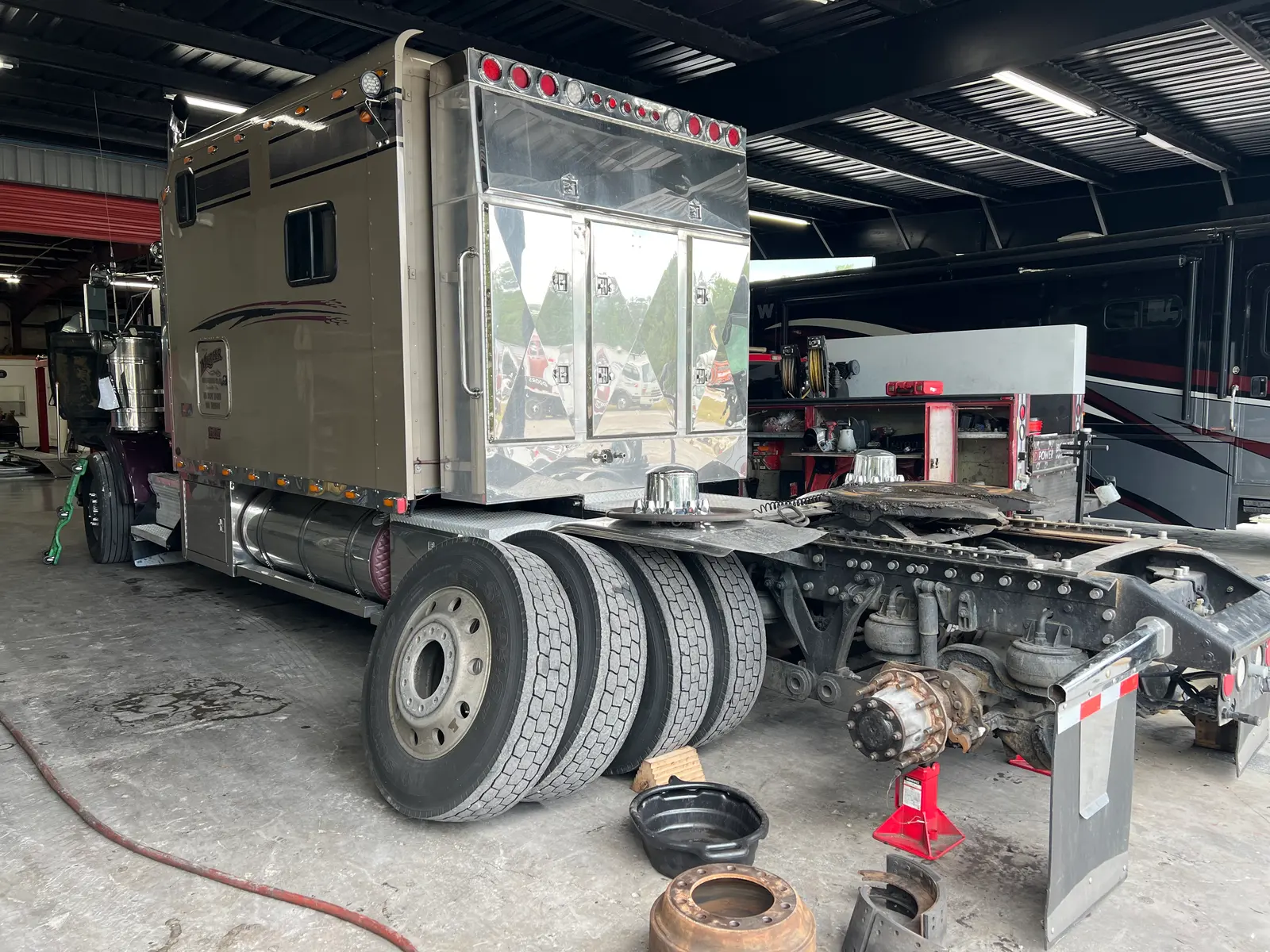
A truck that pulls, wanders or wears the edges off its tires is costing money every mile. RDI Power aligns pickups, medium duty trucks, Class 8 tractors and motorhomes at our Brooksville shop with a laser alignment system made for commercial trucks. Before any angle gets set, the steering and suspension are inspected, because an alignment on worn parts will not hold.
Signs your truck needs an alignment
- Pulling to the left or right on a flat, straight road
- Wander: the truck drifts and needs constant small corrections to stay in the lane
- Off-center steering wheel when the truck is going straight
- Uneven tire wear: a worn inside or outside shoulder, feathered tread edges you can feel with your hand, or steer tires wearing faster than they should. Our guide to signs you need new diesel truck tires shows what to look for.
- Dog tracking: from behind, the truck looks like it is traveling slightly sideways
Vibration is a different problem. A shake in the steering wheel or seat usually points to tire balance, a bent wheel, a damaged tire or the driveline, so we check those before calling it an alignment issue.
What we check and adjust
The inspection comes first
Tie rod ends, drag links, ball joints or kingpins, wheel bearings, the steering gear, bushings, shocks and spring hardware all get inspected. Worn parts let the wheels move out of position under load, and no setting will stay put until they are replaced. If we find wear, you see it in the digital inspection with photos before anything else happens. See shocks and suspension repair.
The angles
- Toe: whether the fronts of the tires point in toward each other or out away from each other. Wrong toe scrubs tread off fast and is the most common cause of feathered wear.
- Camber: the inward or outward tilt of the tire seen from the front. Too much either way wears the inside or outside shoulder.
- Caster: the forward or rearward tilt of the steering axis. It affects straight-line stability and how the wheel returns to center.
- Thrust and axle alignment: on tandem-axle trucks, the drive axles need to be square to the frame and to each other. When they are not, the rear of the truck pushes off at an angle, the steer axle fights it, and every tire on the truck pays for it.
Alignment for every truck class
Pickups and light trucks
Ford Super Duty, Ram, Chevrolet and GMC pickups, the Nissan Titan XD and other light trucks. Heavy pickups that tow and haul load their front ends harder than a car ever will, and solid front axle trucks need the steering linkage in good shape before the alignment is worth doing.
Medium duty work trucks
Box trucks, service body trucks, chassis cabs, buses and other medium duty work trucks. These trucks often carry their weight unevenly, and an alignment matched to how they are actually loaded protects tires and keeps drivers from fighting the wheel all day.
Heavy trucks and tractors
Freightliner, Peterbilt, Kenworth, Mack, Volvo, International and Western Star tractors, dump trucks and vocational trucks. Heavy truck alignment covers the steer axle and the drive axles, because a misaligned drive axle can wear out steer tires that look perfectly aligned on their own. More on our semi and heavy duty truck repair page.
Motorhomes
Diesel pushers and other motorhome chassis, with heavy front axles and long wheelbases where a small error adds up to a lot of tire wear.
Why we look past the numbers
Owner Ryan Bethell tells the story of a refrigerated trailer that came in with inside wear on a rear axle. The owner had already replaced a lot of tires and had been told the rig was aligned. Our technicians saw that the axle itself was flexing under load, and no alignment setting was going to fix that. Reinforcing the axle stopped the flex, and the tire wear stopped with it. That is the difference between setting angles and finding the root cause. Our article on how alignment service works at RDI Power covers more of how we approach it, and we handle the rest of the trailer through our trailer repair service.
What a proper alignment pays back
- Tire life: misalignment scrubs tread off with every mile, and on a truck running 10 or 18 tires that adds up fast.
- Fuel: tires that roll straight instead of scrubbing sideways waste less energy.
- Handling under load: a truck that tracks straight with a full load or a trailer is easier and safer to drive.
- Steering and suspension life: parts last longer when they are not fighting each other.
Our article on the benefits of wheel alignment goes further.
After the alignment
We do not just set the angles and hand back the keys. Every truck gets a test drive to confirm it tracks straight, the wheel is centered and the complaint is gone. Fleet customers can build alignment checks into an RDI Fleet maintenance plan so tire wear gets caught early.
If your truck is pulling, wandering or eating tires, bring it to our Brooksville shop or request service online. We will find out why and fix it so it stays fixed.