
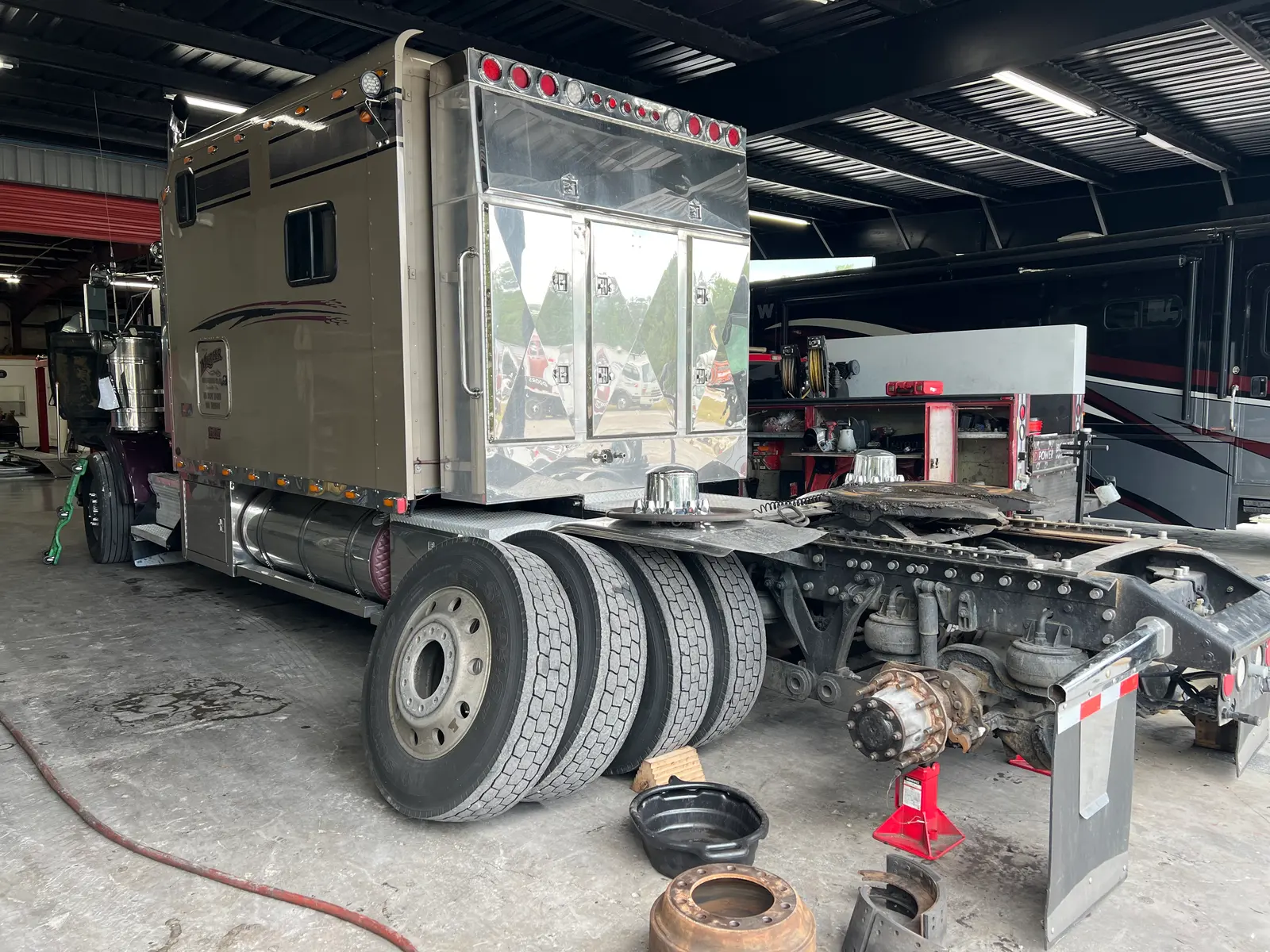
Tires tell the story before the driver does. A truck that has been pulling a little to the right on US-19 for months will show it as a worn shoulder or feathered tread long before anyone books an alignment. RDI Power aligns pickups, work trucks, heavy trucks and motorhomes at our shop in Brooksville, a 24-mile trip from central Hudson, and nobody touches an adjuster until the steering and suspension have been checked.
Boat trailers, tongue weight and Hudson front ends
Many of Hudson’s canal homes keep a boat out back, and if your pickup is the one that tows it, tongue weight is part of how it drives. Tongue weight pushes the rear of the truck down and lifts the front, so the steer tires carry less load and the truck feels lighter and less settled in the wheel. That is a towing setup issue, not an alignment one; a properly adjusted weight-distributing hitch puts weight back on the front axle.
Over time, though, heavy towing wears the parts that hold the alignment in place. Solid-front-axle 4x4s from Ford and Ram are the classic case: once the track bar bushings, ball joints or tie rod ends loosen up, a bump at speed can set off the violent oscillation known as death wobble. Bolting on a new steering damper only muffles it. New parts first, then the alignment, is the order that works.
Sorting out a pull on US-19 north of Hudson
A pull to one side has more than 1 possible cause, and only some of them are alignment. Before we put a truck on the rack, we rule out the others:
- Tire pressure and tire condition. A soft tire or a tire with a shifted internal belt can pull as hard as a bad camber setting. Swapping the front tires side to side is a quick test.
- Brakes. A caliper or wheel cylinder that drags pulls the truck toward that wheel and leaves it hotter than its partner after a drive.
- Bent or worn parts. A tie rod or drag link that took a hit, or a ball joint with play, lets the wheel move under load.
- The angles themselves. Camber or caster that differs from side to side, or a rear axle that is not square to the frame.
Vibration is a separate complaint. A shake in the wheel or seat usually comes from tire balance, a bent wheel or the driveline, and we check those instead of selling an alignment that will not fix it.
Hudson motorhomes and heavy trucks on the rack
Diesel pushers from Hudson’s RV parks put a lot of weight on the steer axle and a long stretch of frame between the axles, so a small toe error scrubs away a lot of tread on every trip. A coach that wanders or needs constant correction gets its steering gear and linkage checked for play along with the angles.
Tandem-axle trucks add a measurement of their own: both drive axles must sit square to the frame and parallel to one another. If they do not, the truck crabs down the road, the steer axle fights the rear, and all 10 tires pay for it. We set the steer axle and check drive axle thrust on tractors, dump trucks and other heavy units.
What a Hudson alignment visit includes
First comes a drive to feel what you feel, then a read of the tread, which often points straight at the angle that is wrong. Every tire is brought to the correct pressure, because a soft one skews the numbers. Toe, camber, caster and thrust are measured, the adjustable ones are brought into spec, and a second drive confirms a centered wheel and straight tracking. Your photo report shows the tread and the front-end parts, so the wear we describe is right there to see.
Fresh rubber on a truck that is out of spec simply starts the same wear pattern over, which is why a new set of tires is the right moment for a check. The warning signs in the tread are covered in our 8 signs you need new diesel truck tires article, and our truck wheel alignment page explains the process for every weight class. Coach owners will find more on the Hudson RV repair page, and drivers on the SR-52 side can read the Bayonet Point truck alignment page. Rack time is booked through the front desk at (352) 433-3800.