
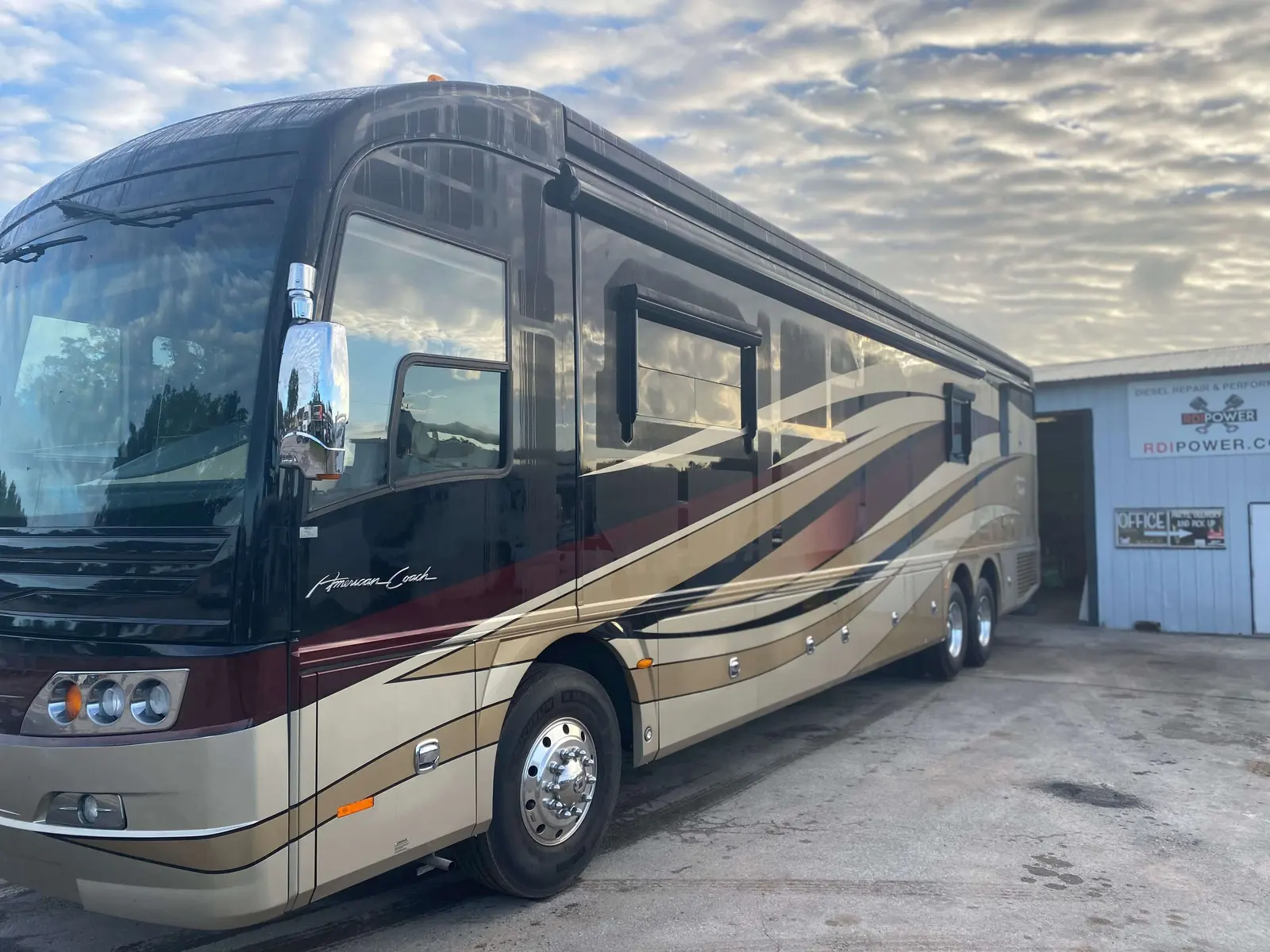
Hudson’s census boundary takes in 2 RV parks, Barrington Hills RV Resort and the Old Dixie Highway RV Park, so motorhomes are part of the everyday traffic here. Under the living quarters of every diesel pusher sits what amounts to a heavy truck, and that is the part RDI Power repairs. Our shop is at 1665 Donto Way in Brooksville, 24 road miles from central Hudson, and our work there sticks to the engine, transmission, chassis, air brakes and suspension.
What a Hudson coach brings to our bays
Most diesel pushers run a Cummins or Caterpillar engine with an Allison automatic behind it. Engine work runs from chasing a derate or a warning lamp to injector, turbo and cooling repairs and routine oil changes; the shop holds Caterpillar certification and is a Bosch dealer for diesel fuel parts. On the transmission, it starts with fluid level, fluid condition and stored codes, and nobody should hear the word rebuild until those 3 checks point there.
Underneath, the chassis gets the same attention a heavy truck would: air brakes, air springs and leveling valves, shocks, the steering gear and linkage, and the driveshaft and U-joints that carry torque from the transmission to the rear axle. A clunk when shifting into gear or a vibration that rises with speed is worth a look before the next long drive.
Driving a pusher from Hudson up US-19
A healthy coach has an easy trip. Pick up US-19 (Commercial Way), stay on it north into Hernando County, then turn east on SR-50 into Brooksville. There is no toll road on the way, and once you are on US-19 the route avoids tight neighborhood streets. Give us the coach’s length and height when you book, so the right bay is open when you pull in.
A sick coach is another matter. Coolant on the ground, an air pressure warning or a transmission holding 1 gear can all turn expensive somewhere along 24 miles of US-19. Phone (352) 433-3800 first. Often the first step is a technician at the campsite with a scan tool; if the coach truly needs the bays, we work out the tow with you. Moving a pusher calls for a heavy wrecker, and the driveline usually gets uncoupled or the drive axle lifted so the Allison is not spun without lubrication, so tell the towing company up front that the engine sits in the rear.
Air brakes and air bags on Hudson motorhomes
Coaches here live in warm, humid Gulf air, and a compressor that pulls in wet air puts more moisture into the system. The air dryer is what keeps that water out of the tanks, valves and brake chambers, so keeping the dryer cartridge on schedule matters. Signs the air side needs attention:
- Air that is slow to reach cut-out pressure after a cold start
- A coach that leans or will not level, which can be a leaking air spring or a failing leveling valve
- An audible leak with the system aired up and the brakes applied
- Brake chambers or slack adjusters that look out of adjustment on a walkaround
On coaches with hydraulic brakes, calipers and slide pins can stick after a long sit, and that shows up as a pull or a hot wheel on the first drive.
Cooling stacks and engine heat on Hudson pushers
A rear engine lives in a tight, hot compartment, and the radiator and charge air cooler stacked at the back pull in road grime. Once the fins load up, a coach can start running hot on a long pull even though no part has technically failed. We clean and inspect the cooling stack before condemning a radiator, a fan drive or a water pump.
You get pictures and the technician’s write-up on every coach, and our labor warranty runs 3 years / 36,000 miles. The owner’s half of a pre-trip routine is in our long-distance RV maintenance checklist, and the broader picture of motorhome work lives on the RV service and repair page; a coach that wanders or wears its front tires unevenly should also read truck alignment in Hudson, and owners near Tropic Breeze can see the Bayonet Point RV repair page.