
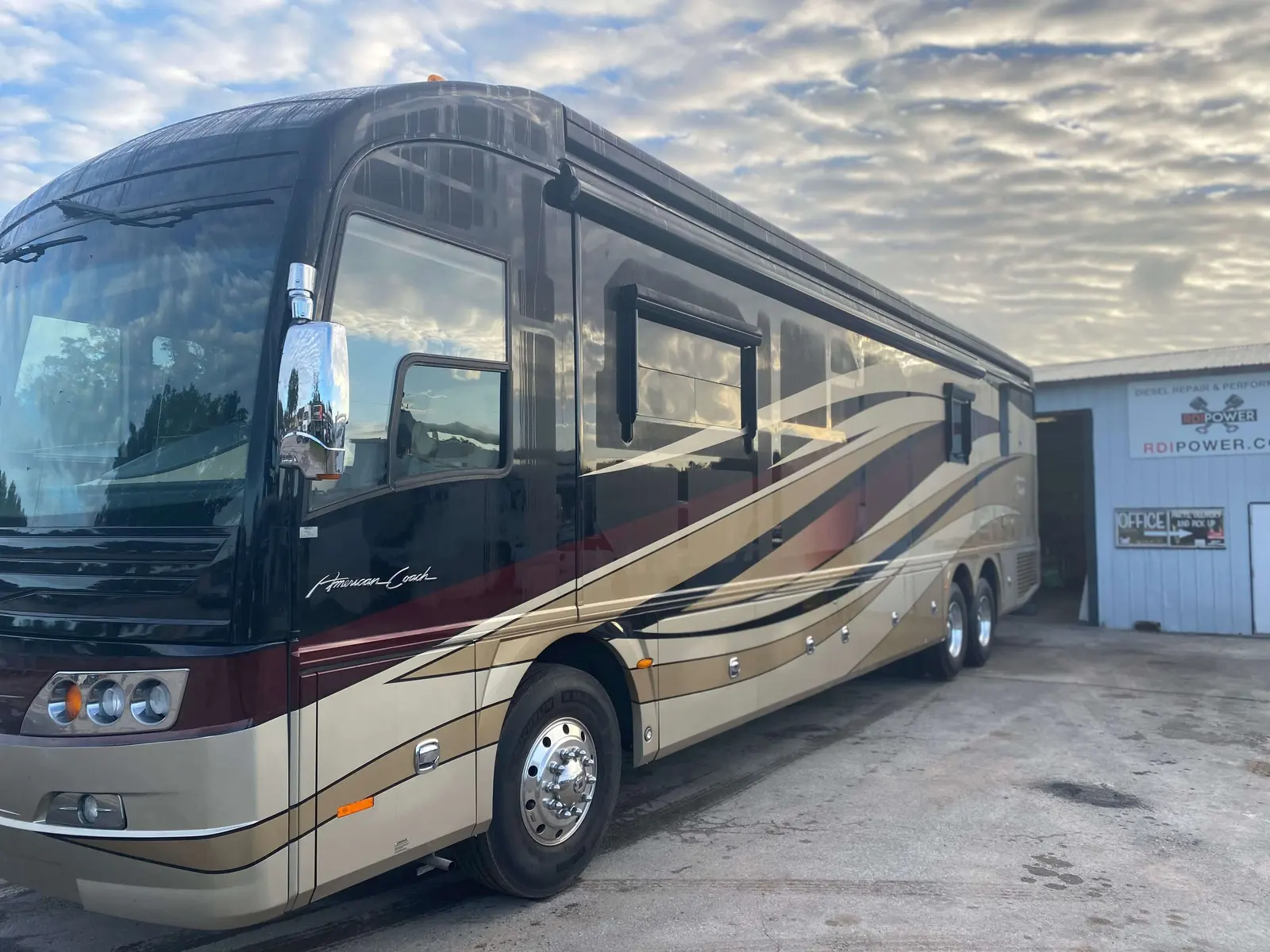
A diesel pusher is a heavy chassis with a house on top, and RDI Power works on the chassis: the engine, the transmission, the air brakes, the suspension and the steering. Coaches from Timber Pines reach our Brooksville shop in about 28 minutes, roughly 16 road miles up US-19 and across SR-50. The work is done by diesel technicians who spend their days on the same engines and Allison transmissions found in heavy trucks and buses.
Moving a coach from Timber Pines Boulevard to Donto Way
The route is straightforward for a big rig. Leave by Timber Pines Boulevard, take US-19 north about 4 miles to the SR-50 junction at Weeki Wachee, and follow Cortez Boulevard east into Brooksville. Phone ahead at (352) 433-3800 with the coach’s length, height and symptoms, which lets us have a bay open when you pull in.
Driving it is only the right answer when the coach is healthy. A low-air buzzer, a coolant gauge that keeps climbing, an Allison that has dropped into a fixed gear or heavy smoke at startup all mean the coach should stay put. Then a mobile technician can often work out the problem where the coach is parked, at a storage yard or a campground, and when the shop is the answer, we help arrange a heavy wrecker. Make sure the tow operator knows the coach has a rear engine; the driveshaft has to be dealt with correctly so the transmission is not damaged on the hook.
Air brakes and air suspension on Timber Pines coaches
On most diesel pushers, the brakes and the suspension both run on air from a single engine-driven compressor. That makes the air system the first place we look:
- Compressor and dryer: how fast the system builds pressure from empty, whether the governor cuts in and out where it should, and whether the dryer cartridge is due.
- Leaks: a coach that settles overnight or takes a long time to air up has one somewhere, in a bag, a fitting, a leveling valve or a brake component.
- Brakes: chambers, slack adjusters, drums or rotors and linings, measured and photographed.
- Suspension: air bags for cracking and chafing, shocks, bushings and the height control valves that keep the coach level.
Engine and Allison work for coaches near Timber Pines
The usual powertrain in a pusher is a Cummins or Caterpillar diesel paired with an Allison automatic. Engine work runs from warning lights and derates to fuel injection, turbochargers and cooling system repairs, plus oil, fuel filter and coolant service on schedule; RDI Power is Caterpillar certified. A coach that sits for weeks between trips has particular weak spots, including batteries, fuel that collects water, and belts and hoses that age whether the coach moves or not.
On the Allison, we start with fluid level and condition and the stored codes, then road test. A harsh or delayed shift is a symptom to diagnose, not a reason to assume a rebuild, and we show you the evidence before recommending one.
Steering, alignment and tires on a Timber Pines motorhome
Tires on a coach that travels a few months a year often age out before the tread wears down, so we read the date codes as well as the tread. Uneven wear, a wandering feel at highway speed or a steering wheel that sits off center calls for a front-end check and an alignment; our Timber Pines truck alignment page explains what the wear patterns mean. Before a long trip, work through our long-distance RV checklist on your own as well.
Every coach gets a digital inspection with photos and technician notes, and the labor carries a 3-year / 36,000-mile warranty. The full scope is on RV service and repair, and coach owners closer to the Gulf canals farther south can see Hudson RV repair.