
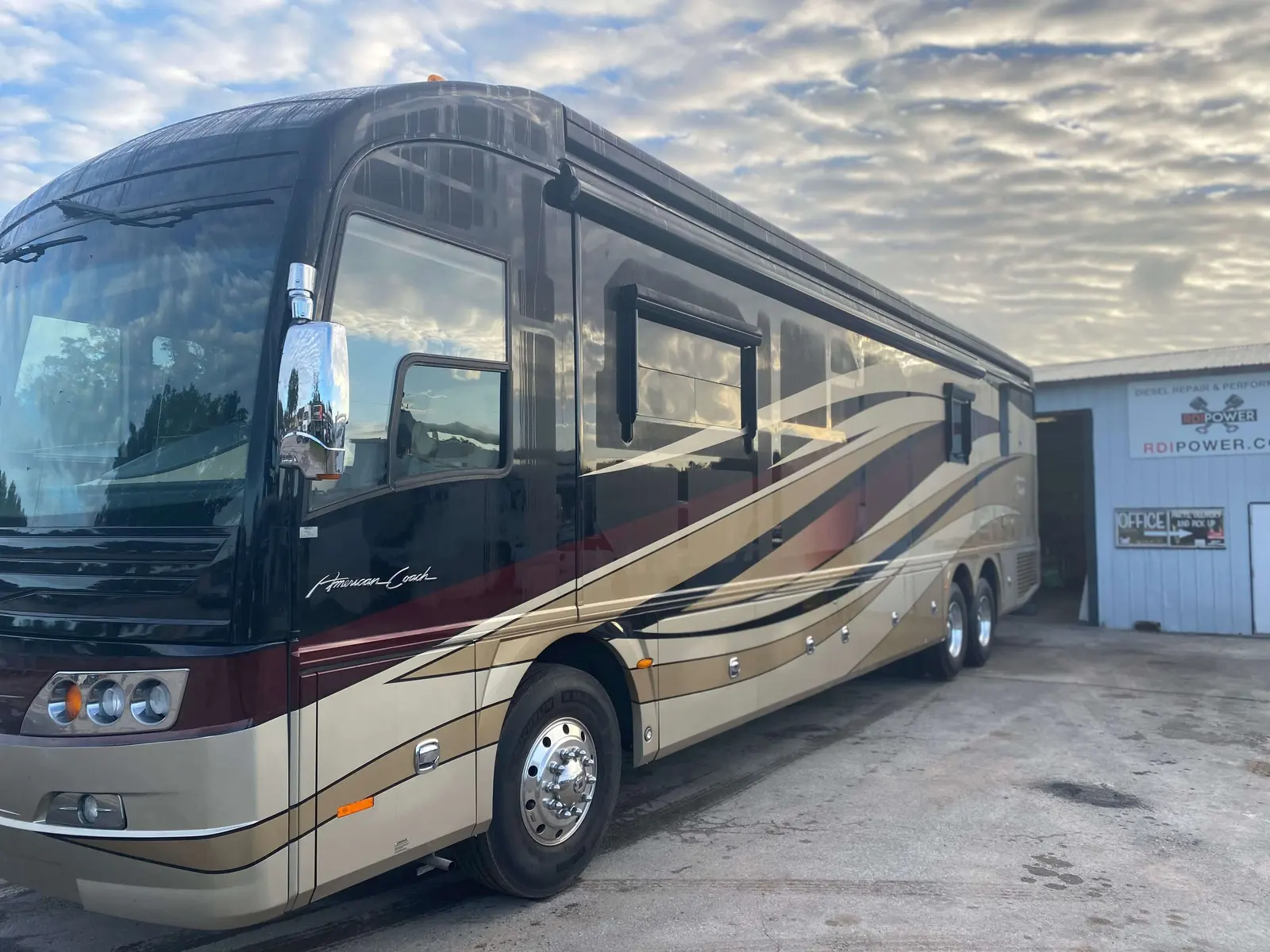
A diesel pusher is a heavy truck with a house built on it, and the truck part is our business. RDI Power services and repairs the engine, transmission and chassis of diesel motorhomes at our Brooksville shop, about 12 road miles from the middle of Spring Hill. This page covers 2 kinds of visit: a coach checked over before a trip, and a coach fixed after something went wrong on one.
Before the run north: a chassis and drivetrain check
A long trip asks a lot of a coach that may have sat for weeks in a driveway or a storage lot. Before you head out, we look at the items that can strand a pusher far from home:
- Air system: compressor output, the air dryer, leaks, and the chambers and slack adjusters on the air brakes, plus the air bags on the suspension.
- Cooling: coolant condition, hoses, belts and the radiator, which on a rear-engine coach can collect debris where you cannot see it.
- Driveline: U-joints and the driveshaft between the transmission and the rear axle. A failing U-joint usually gives warning as vibration or a clunk before it lets go.
- Steering and suspension: gearbox, tie rods, shocks and bushings, plus alignment if the tires show uneven wear; our Spring Hill truck alignment page explains what wear patterns mean.
- Fluids: engine oil, coolant and transmission fluid levels, leaks and condition, with oil, fuel filter and transmission service as the schedule calls for.
Our RV maintenance checklist for long-distance travel covers the owner’s side of the list.
Warning signs on the road
Coaches usually announce trouble before it strands them. Air pressure that takes longer than usual to build after a start points to a tired compressor, a leak or a failing dryer. A sweet coolant smell from the back, or a temperature gauge that creeps up on hills and in traffic, says the cooling system needs a look. A vibration that comes and goes with speed can be a driveshaft or U-joint. Steering that needs constant correction can mean a worn gearbox or loose linkage. Any of these is worth a call before the next trip rather than after it.
Getting a pusher from Spring Hill to Brooksville
If the coach is healthy, the drive is simple: SR-50 east from the north side of Spring Hill, or the Suncoast Parkway north to Exit 46 and then SR-50 east into Brooksville. Call ahead so the bay is ready for your coach’s length and height.
If the coach is not healthy, think before you drive it. A coolant leak, an air pressure warning or a transmission in limp mode can get much worse in 12 miles. Call (352) 433-3800 and describe what is happening. If it should not be driven, a mobile technician may be able to diagnose it on site, and if it needs the shop, we can help plan the tow. Towing a pusher takes a heavy wrecker, and the operator will usually disconnect the driveshaft or lift the drive wheels so the transmission is not damaged. Say it is a rear-engine diesel pusher when you call the tow company.
Engine and Allison work on the coach
Most diesel pushers carry a Cummins or Caterpillar engine and an Allison automatic. Engine work includes diagnosing derates and warning lights, fuel injection, turbochargers, cooling system repairs and scheduled oil and filter service, and RDI Power is Caterpillar certified. On the Allison, we start with fluid level and condition and the stored codes; a shift complaint is not a rebuild until the evidence says so. You get pictures and technician notes from the digital inspection on every coach, and RDI Power stands behind the labor for 3 years / 36,000 miles.
For more on motorhome work, see RV service and repair. Owners closer to the county seat can read about storage-season service on our Brooksville RV repair page.