
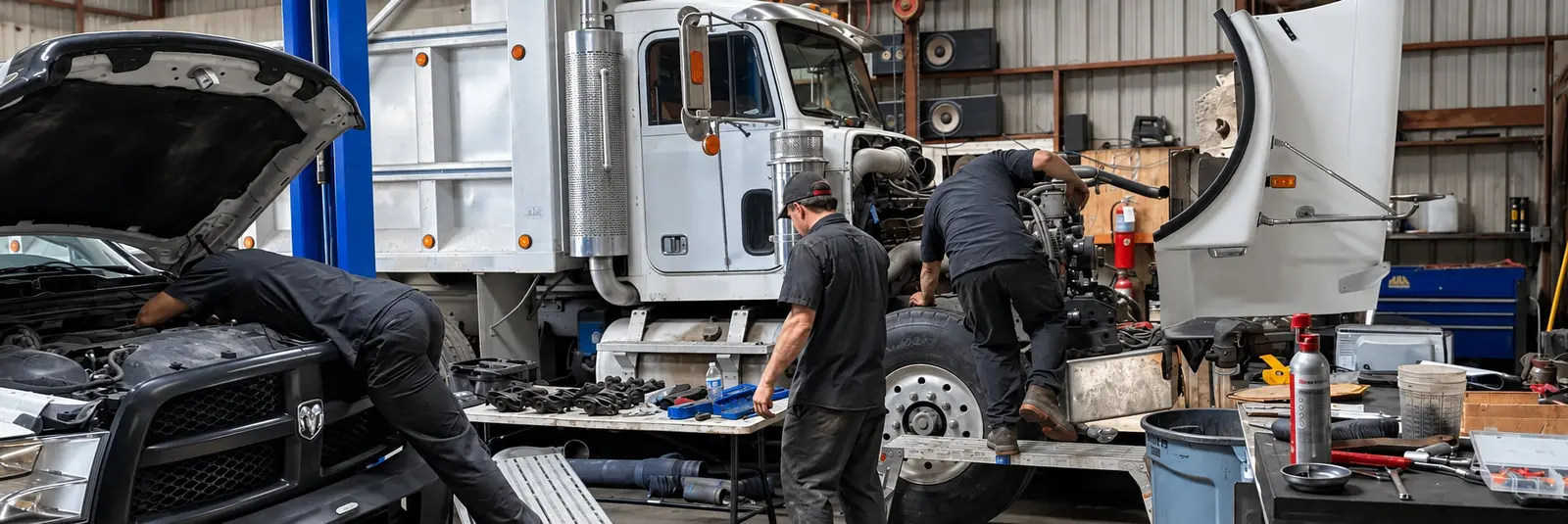
Hudson’s heavy freight once rode on rails. In 1904 the Brooksville and Hudson Railroad replaced a turpentine tram road between the 2 towns, built on the promise that Brooksville would gain direct water transportation through Hudson. Today the hauling happens on US-19, and the trucks doing it need a heavy-duty shop within reach. RDI Power’s bays are at 1665 Donto Way in Brooksville, and our mobile technicians cover the 24 road miles in between.
Hudson tractors on US-19 and the side roads
US-19 (Commercial Way) carries the through traffic. Off it, Hudson Avenue and Fivay Road run between the coast and the inland side, Little Road (CR 1) turns south near Denton Avenue, and Old Dixie Highway, known locally as Old 19, links the waterfront neighborhoods. A tractor that works local stops along these roads spends a lot of its day at low speed or idling at a dock, and that duty cycle decides what fails first.
Low-speed work keeps exhaust temperatures down. The particulate filter loads faster, regens come closer together, EGR valves and coolers soot up, and NOx sensors and DEF dosers work harder than they would on a highway run. Eventually the truck derates. A forced regen can get it moving. Lasting repair means identifying what keeps feeding the filter, whether that is how the truck is used, an injector that dribbles, air escaping from the boost side, oil getting past a turbo seal or a sensor giving bad readings. Our exhaust and emissions repair page shows how we trace it.
Humid Gulf air and Hudson air brakes
Hudson sits on the Gulf, and the air a compressor pulls in here is often warm and wet. When that air is compressed, the moisture condenses, and the air dryer’s job is to catch it before it reaches the tanks, valves and chambers. A cartridge past its interval, a purge valve that sticks or tanks that never get drained let water through, and water in an air system means rust, sticking valves and slow brake release.
On the foundation side we work on compressors, governors, dryers, valves, lines, S-cam drum brakes, slack adjusters, chambers, spring brakes and air disc brakes, plus the ABS sensors and modulators. An automatic slack adjuster that keeps needing manual adjustment is a symptom, not a maintenance item; it usually points to worn cam bushings, a failing adjuster or a foundation brake problem. Hudson owners who want the detail on air brake parts and adjustment can find it on our brake systems page.
A tractor stopped on US-19 near Hudson
If a truck quits on Commercial Way, coast it clear of traffic if you can, put out the warning triangles, then phone (352) 433-3800. Give the direction of travel and the nearest cross street, such as Hudson Avenue, Fivay Road or the Little Road turn, plus the engine make, any codes on the dash and what happened before it stopped. Plenty of breakdowns end right there with a mobile technician: air leaks, electrical faults, failed sensors, fuel filter problems, starters and alternators.
Fleet customers can call any hour of any day; for everyone else, technicians go out during weekday shop hours. The Hudson mobile diesel repair page explains how on-site calls work.
Heavy bay work for Hudson trucks in Brooksville
Engine overhauls, injector and turbocharger jobs, aftertreatment repairs, clutches and anything that needs the truck on a lift come to the shop. The tractors we see run the full range of heavy makes, Freightliner to Western Star, and the engines span Cummins, Detroit, Volvo and Caterpillar, the last backed by our Caterpillar certification. When a tow is unavoidable, it is a run north on US-19 and east on SR-50, and the diagnosis from the roadside visit rides along so nobody starts over.
Whatever a truck came in for, its brakes, tires and suspension end up photographed in the inspection report. Labor is backed for 3 years or 36,000 miles, and fleet repairs under RDI Fleet for 2 years or 24,000 miles. Everything we do on big trucks is listed under semi and heavy-duty truck repair; tractors based where SR-52 meets US 19 have their own page, Bayonet Point semi truck repair.