
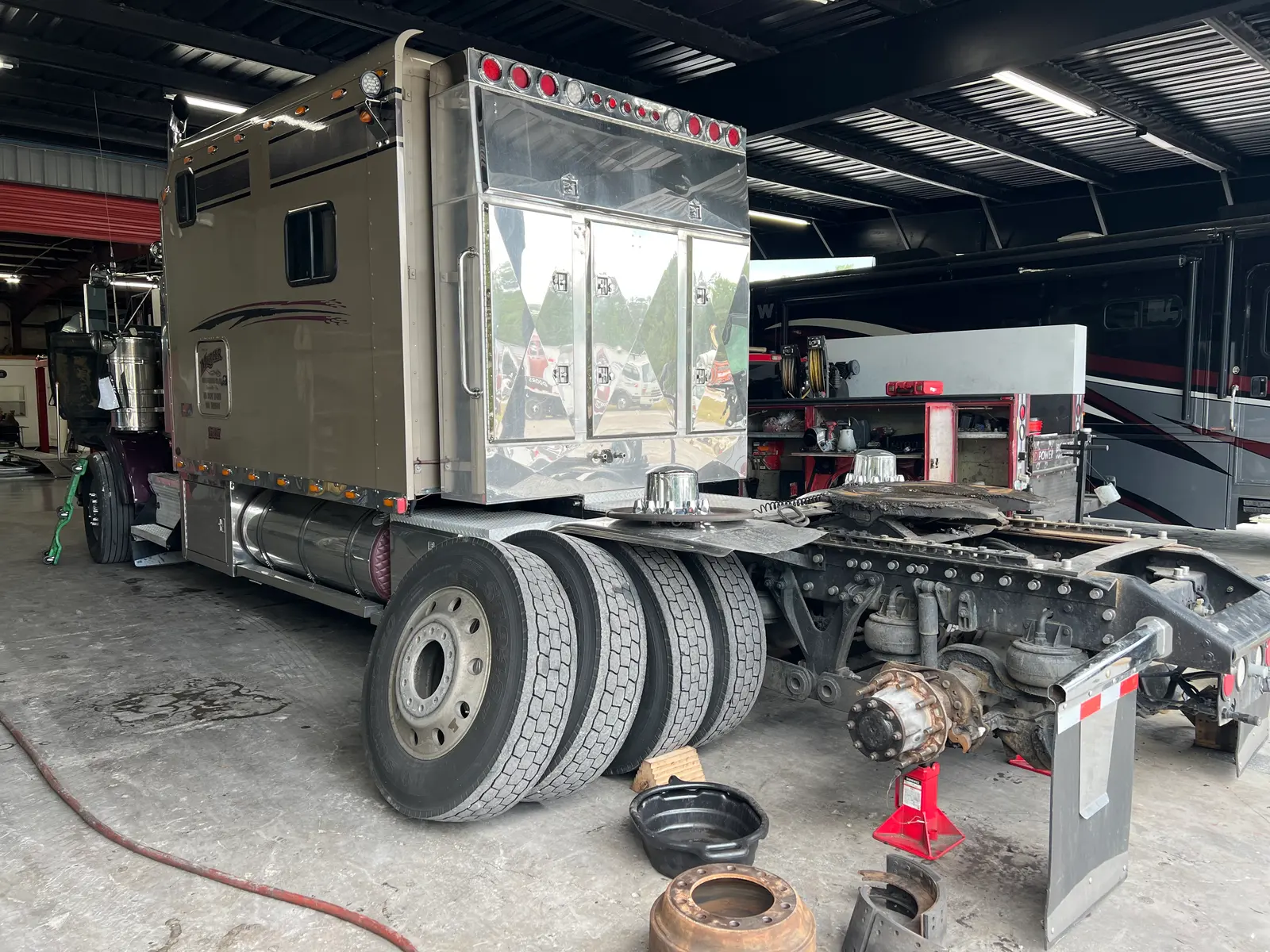
Alignment trouble is cheap to fix and expensive to ignore, because the cost lands in tires. If a River Ridge truck commutes by the Ridge Road Extension and the Parkway, it piles up steady highway miles, and at highway speed a small error scrubs rubber off every revolution. RDI Power aligns pickups, vans, heavy trucks, buses and motorhome chassis at 1665 Donto Way in Brooksville, about 29 road miles from central River Ridge, and the first thing we look at is not the angles but the parts that hold them.
What River Ridge tires say about the alignment
A tread depth gauge tells more than a glance. Measure each front tire at the inner groove, the center and the outer groove:
- Inner or outer groove much shallower than the rest. Camber is off, or a worn ball joint, kingpin or control arm bushing is letting the wheel lean.
- Ribs with a sharp edge on one side. Run your hand across them; a sawtooth feel is the classic sign of a toe problem.
- Center worn faster than the edges. Usually overinflation, not alignment.
- Patchy dips around the tire. Often shocks or balance, which an alignment alone will not fix.
- Rear tires worn on a diagonal. The rear axle may be out of square, sending the truck down the road at a slight angle.
Bring the old tires or photos of them when you come in. They are the history of how the truck has been running.
Steering play first, angles second, for River Ridge trucks
An alignment set on loose parts drifts out again within weeks. So before the truck goes on the rack, we check the steering gear and its mounts, tie rod ends, the drag link, ball joints or kingpins, and on solid-axle 4x4 pickups the track bar and its bushings. Worn parts get replaced first. On heavy-duty Ram and Ford trucks with solid front axles, worn track bars and tie rods can cause a violent shake after hitting a bump at speed, and no alignment cures that until the parts are right.
Modified trucks need a word up front. A leveling kit, a lift or larger tires change ride height and geometry, and we need to know what has been changed to set the truck correctly.
Heavy trucks and coaches from River Ridge on the alignment rack
Big trucks wear tires for the same reasons, only faster and at greater cost. On a tractor or dump truck we set steer axle toe, check camber and caster, and square the drive axles to the frame and to each other, so the truck tracks straight behind its own front wheels. Buses and motorhomes go on the same rack. On an air-ride coach, ride height is checked first, since a leaking air bag or misadjusted height control valve throws off every reading; our River Ridge RV repair page covers that side of the chassis.
Booking a River Ridge alignment around the 40-minute drive
The trip from River Ridge runs east on the Ridge Road Extension, north on the Parkway from Exit 25 and east on SR-50 into Brooksville. If you suspect worn steering parts, say so when you call (352) 433-3800, along with the year, make, symptoms and tire wear, so the visit can be planned around them.
At the shop, the truck gets a road test, a tire check with pressures set, a front-end inspection, measurement and adjustment of toe, camber, caster and thrust, and a second road test. Photos of the tire wear and any worn parts go into your digital inspection with the technician’s notes, and the labor carries our 3-year / 36,000-mile warranty. For more on why alignment pays for itself, read how alignment service at RDI Power ensures peak performance. Our truck wheel alignment page covers the service in depth, and drivers west on Ridge Road can see the Jasmine Estates truck alignment page.