
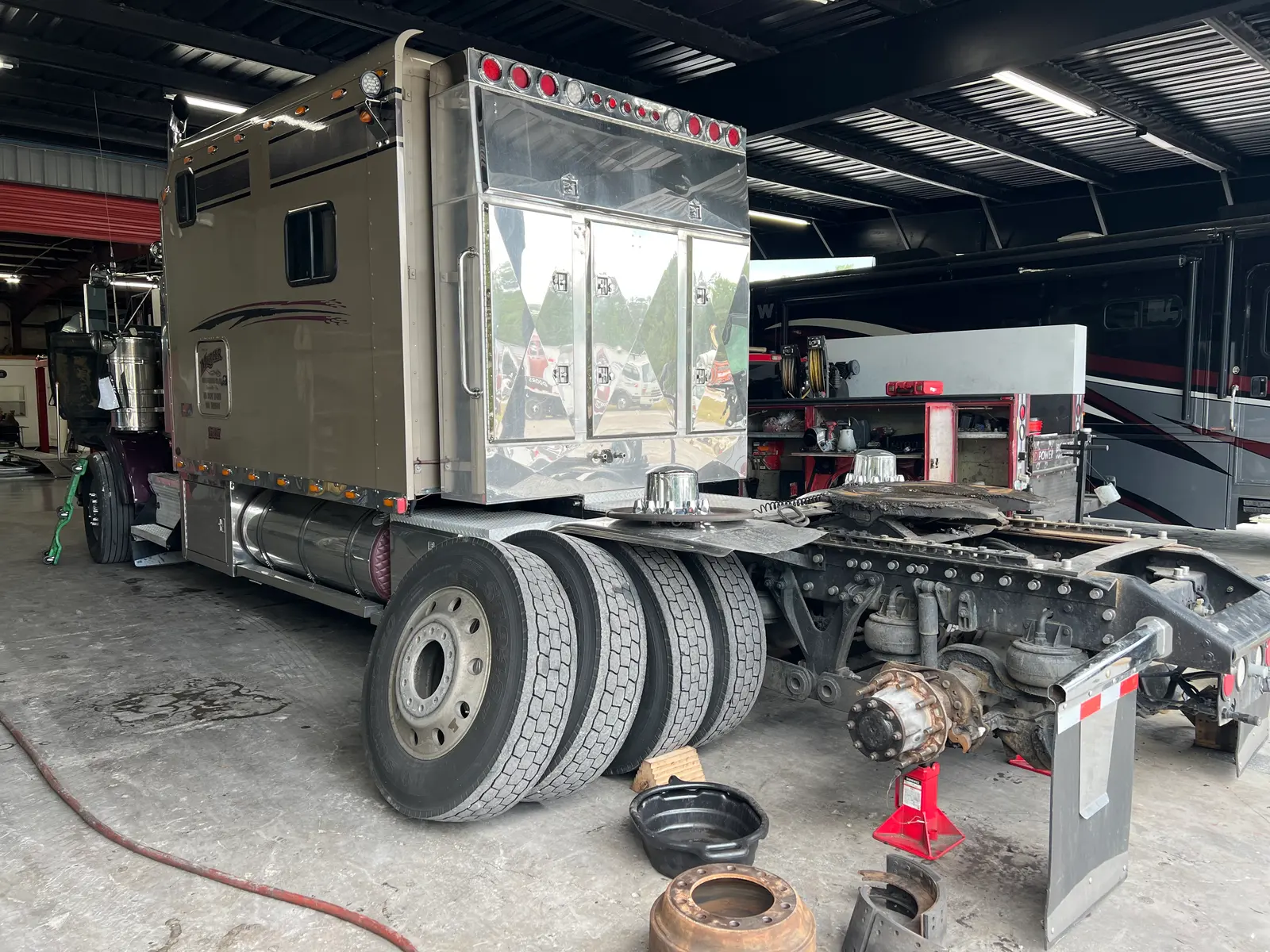
On a truck, alignment is a tire budget decision as much as a handling one. Every degree of toe or camber out of spec scrubs rubber with every mile, and on a truck running 6, 10 or 18 tires that adds up quickly. RDI Power aligns pickups, medium duty trucks, buses, motorhomes and tractors at our Brooksville shop, about 24 road miles from central Inverness.
Inverness trucks that pull, wander or eat tires
3 complaints bring most trucks to the alignment rack, and each points somewhere different.
A pull. The truck heads steadily to one side on level pavement. Mild drift toward the curb on a crowned street like Florida Avenue is normal; a pull you have to hold against is not. Causes range from a caster split to a dragging brake to a tire with a shifted belt, so we check tires and brakes as well as the angles.
Wander. The truck needs constant small corrections to stay in its lane, typically noticed at speed on a road like SR-44. Wander usually starts with play: a worn tie rod end, ball joint, kingpin, track bar bushing or steering gear. Alignment alone cannot fix it.
Early tire wear. Feathered edges point to toe, a worn shoulder to camber, cupping to shocks or balance, and steer tires that wear differently from each other to a worn or bent part on one side.
Before the truck goes on the rack, the front end gets checked for play, and anything worn shows up in the digital inspection with photos so you can decide on the repair first.
Long wheelbases from Inverness: buses, coaches and tandem trucks
Buses, diesel pushers and tandem-axle trucks need more than a front-end alignment. Their rear axles have to sit square to the frame, and on tandems, parallel to each other. When they do not, the vehicle crabs slightly down the road, the steering wheel sits off center to compensate, and every tire scrubs. We measure and correct the rear first, then set the steer axle’s caster, camber and toe to the line the rear actually travels. On heavy steer axles, kingpin play is checked before any adjustment, because a loose kingpin will not hold a setting.
Leveled pickups around Inverness and their steering geometry
Lift and leveling kits change the geometry the factory designed. A solid front axle that has been raised loses caster and can shift off center unless the track bar is corrected. Torsion-bar trucks raised by adjusting the bars change camber and toe. Bigger tires add leverage on every steering part. A truck that has pulled or chewed tires since the kit went in usually needs an alignment, and sometimes an adjustable part, to drive straight again. Our tire service covers replacements, and the article on 8 signs you need new diesel truck tires shows what to look for.
Any repair that replaces tie rods, a drag link, ball joints, kingpins or a steering gear includes an alignment, so the new parts do not start a new tire problem. Alignment labor on Inverness trucks carries our 3-year, 36,000-mile warranty.
Alignment checks on an Inverness fleet’s PM calendar
Fleets lose the most money to slow, quiet tire wear that nobody notices until a set is ruined. On an RDI Fleet plan, the technician measures tread depth and reads wear patterns at every PM, and a unit whose steer tires start to feather gets flagged for the rack before the damage spreads. Pairing an alignment with a scheduled shop visit keeps the truck from making a separate trip south.
The full process is described on our truck wheel alignment page, coach owners can read about chassis care on the Inverness RV repair page, and trucks parked along Pleasant Grove Road are covered by the Inverness Highlands South truck alignment page. Call (352) 433-3800 to get your Inverness truck on the rack.