
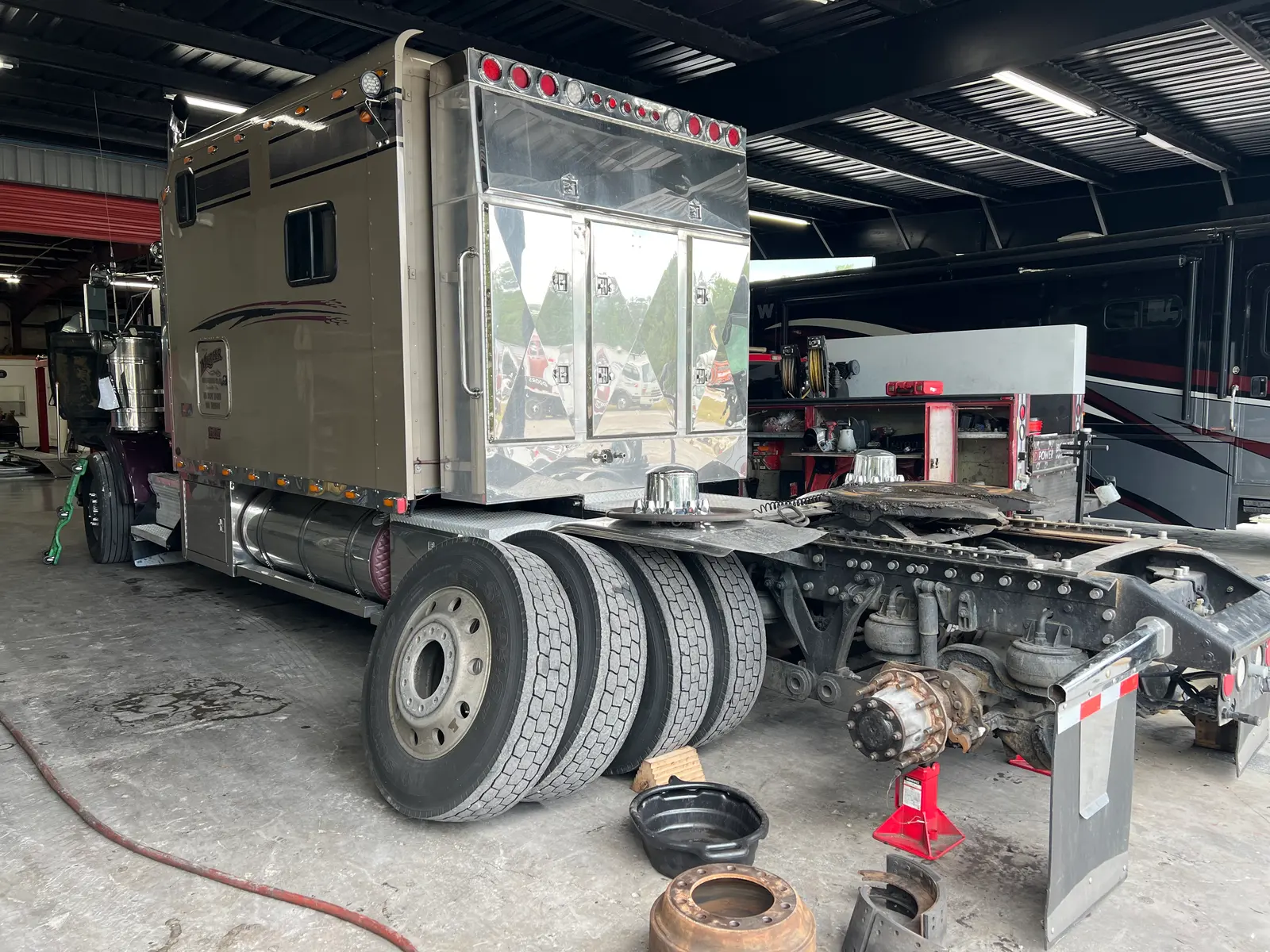
Most of what RDI Power does can happen in a yard or on a shoulder. Alignment cannot. Setting toe, camber, caster and axle thrust takes a rack and an alignment system built for commercial trucks, and ours is at 1665 Donto Way in Brooksville, about 17 road miles from the middle of Sugarmill Woods. That makes planning part of the job: an alignment is worth the most when it rides along with new tires, a PM visit or front-end repairs.
Making the US-98 trip count for a Sugarmill Woods alignment
A few combinations make sense:
- With new tires. Mounting new rubber on a truck that is out of alignment starts the same wear pattern over again. Aligning on the same visit protects the investment.
- With front-end work. Replacing tie rod ends, a drag link, ball joints, kingpins or a steering gear changes the angles, so the alignment is part of the repair.
- With a PM visit. Fleet units can have an alignment check folded into scheduled maintenance, so tire wear gets caught before it shows up as a blowout or a replaced set.
If the truck is due for more than one of those, we line them up for the same morning.
What drivers feel on Suncoast Boulevard and the Parkway
Some alignment problems announce themselves before the tires show anything:
- A steady pull to one side on a flat stretch. Road crown pushes every truck slightly toward the edge, but a pull that needs real effort to hold is something else.
- Wander, where the truck needs constant small corrections to stay centered in its lane at Parkway speed.
- A crooked steering wheel while the truck tracks straight.
- Dog tracking, where a following driver sees the truck running slightly sideways down the road. That points to the drive axles, not the steer axle.
A vibration through the seat or the wheel is usually a balance, wheel or driveline problem rather than alignment, and we check those before setting any angles.
Front-end parts before angles on Sugarmill Woods trucks
A rack will happily set perfect numbers on a truck with a loose front end, and those numbers will be wrong again by the end of the week. So the inspection comes first: tie rod ends, drag link, ball joints or kingpins, wheel bearings, the steering gear, bushings, the track bar on solid-axle trucks and the shocks. Worn parts show up in the digital inspection with photos and notes before we recommend anything, so you can see the play for yourself.
Pickups, work trucks, buses and pushers from Sugarmill Woods
Ford and Ram 4x4 pickups. Solid front axles depend on a healthy track bar and steering linkage. A lift or leveling kit reduces caster and can shift the axle sideways unless it is corrected.
GM heavy-duty pickups. Independent front suspension, often leveled by cranking the torsion bars, which changes camber and toe.
Chassis cabs and service-body trucks. These often carry weight unevenly, so the alignment should match how the truck is actually loaded.
Buses, diesel pushers and tractors. Long wheelbases and heavy front axles magnify small errors, and on tandems the drive axles must be square to the frame before the steer axle is set to them.
After the angles are set, every truck gets a road test to confirm it tracks straight with a centered wheel. Our truck wheel alignment page explains the process in depth, and our guide to signs you need new diesel truck tires shows which wear patterns matter. Drivers based farther north can use our Homosassa Springs truck alignment page.
Call (352) 433-3800 to book the rack, and tell us about any tires or front-end work you want done on the same visit.