
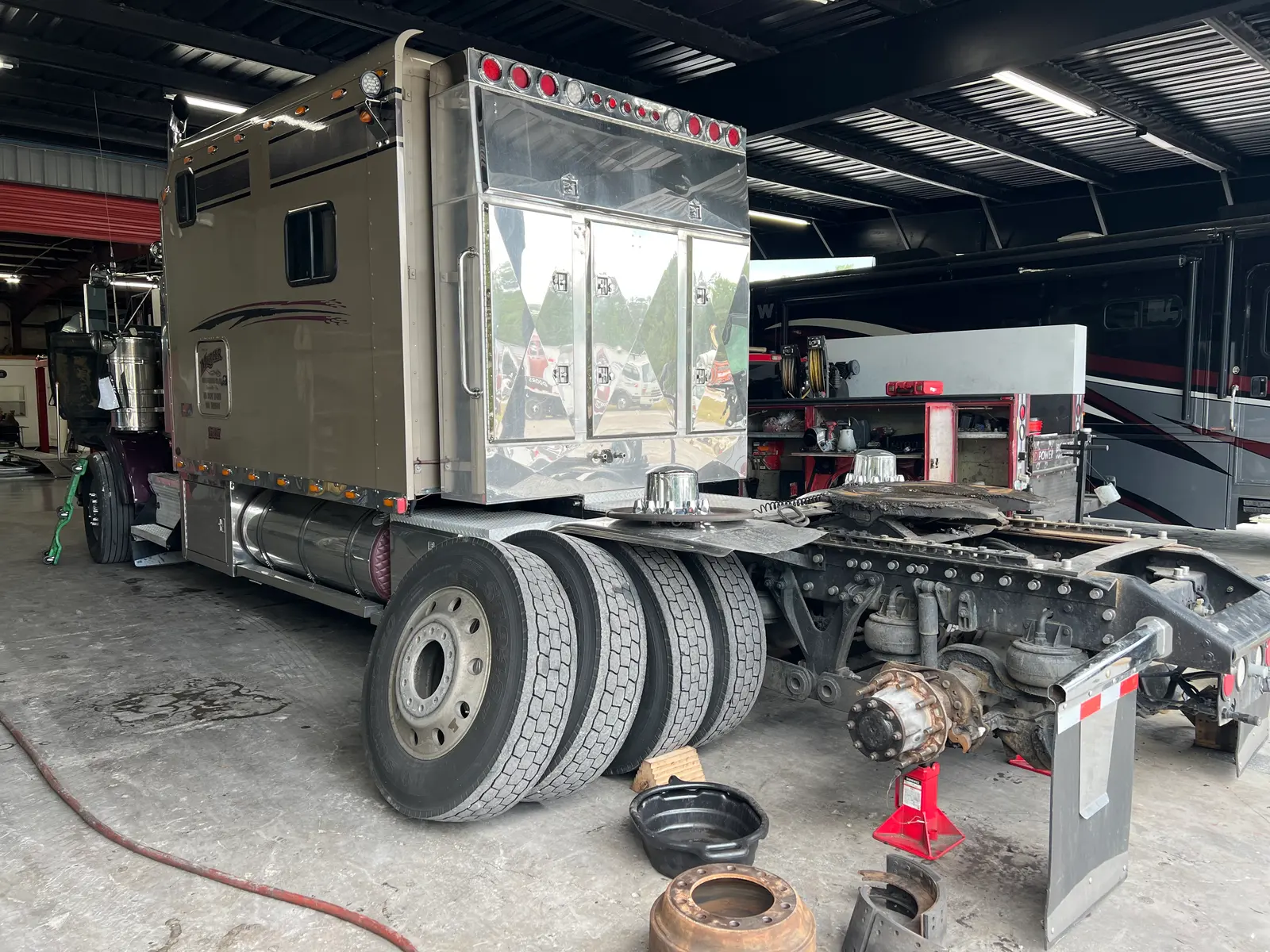
An alignment is only as good as the parts it is set on. That matters in Lecanto, where pavement like SR-44 and CR-491 sits a few miles from the rougher ground of the sand pits west of the Suncoast Parkway and the county landfill on Gulf to Lake Highway. RDI Power aligns light, medium and heavy duty trucks at 1665 Donto Way in Brooksville, about 23 road miles from central Lecanto, and every alignment starts with a hard look at what holds the wheels in place.
Steer axles on Lecanto job-site trucks
A truck that works in a pit or across landfill ground takes hits a highway truck never sees: ruts, rocks, dropped edges and the occasional stump. Each hit is a chance to knock toe out of spec or bend a steering component, and loaded trucks hit harder. The result is a steer tire that wears one shoulder, a truck that pulls toward the ditch, or a steering wheel that no longer sits straight.
If your trucks run that kind of ground, check steer tire wear every time the truck is fueled. A tire that is suddenly wearing differently from its partner is telling you something changed, and catching it early saves the rest of the tread.
Kingpins and tie rods on Lecanto medium-duty trucks and buses
Most medium and heavy trucks, and most buses, steer on a solid front axle with kingpins, and the kingpin bushings are where play builds up. We lift the axle and check each wheel for movement up and down and side to side, then measure it against the limit. Tie rod ends, the drag link and the steering gear get the same scrutiny. A worn part can let toe change as the truck rolls, so a truck can leave a rack measured perfectly and still wear tires like it was never aligned. Fixing the parts first is the only alignment that lasts. On a bus or a box truck, that also means checking the steering gear mounting and the springs, because a cracked leaf or a shifted axle can pull the truck off line no matter what the front settings read.
Lecanto pickups after a curb, pothole or soft shoulder
Pickups have their own pattern. A hard hit on a curb, a pothole or a dropped shoulder can bend a tie rod or drag link on a solid-axle 4x4, and the first symptom is often a steering wheel that sits off center while the truck goes straight. Some solid front axles have little factory adjustment for camber and caster, so correcting them after a hit or a lift can take an offset part rather than a turn of a bolt. Independent front ends on GM heavy-duty trucks have more adjustment but are just as sensitive to worn ball joints and steering linkage.
On the rack: a Lecanto alignment visit
The visit starts with a short road test to feel the complaint, then a read of the tire wear and a check of steering and suspension parts for play. Tire pressures are set before anything is measured. Then toe, camber, caster and the rear thrust angle are measured, adjusted where the truck’s design allows, and confirmed with a second road test. The digital inspection records the tires and front-end parts in photos, so you see the wear we are describing.
New tires on a misaligned truck wear the same way the old ones did, so pair a tire purchase with an alignment check; our tire service covers the tires themselves. For the full process, see truck wheel alignment. Coach owners can read about ride height and air suspension on our Lecanto RV repair page, and the community just north has a Citrus Hills truck alignment page. Call (352) 433-3800 to book rack time.