
A transmission complaint from Lecanto has to answer a practical question before a technical one: can the truck safely cover the 23 road miles to Brooksville? Sometimes the answer is yes, sometimes it is a tow, and sometimes a mobile technician with a scan tool settles it on the spot. Once the truck is in our shop at 1665 Donto Way, the work is the same for every unit: find out why it is misbehaving, then repair, rebuild or replace based on what the evidence shows.
Towing out of Lecanto in tow/haul mode
A pickup that pulls a camper or an equipment trailer east on SR-44 toward Inverness, west toward Crystal River, or south on the Parkway puts its transmission to work in a way that commuting never does. Tow/haul mode exists for exactly that. It holds each gear longer, keeps the transmission from hunting between gears on gentle grades, and on most current diesel pickups works with the exhaust brake to slow the load without cooking the service brakes. Towing in plain drive lets the transmission shift up early and drop back down repeatedly, and every one of those cycles slips the converter and adds heat.
Watch the transmission temperature on the dash. If it reads higher than it used to with the same trailer on the same road, the cooler may be partly blocked or the fluid may be breaking down, and both are cheaper to fix early.
Allison automatics and PTOs on Lecanto work trucks
Allison automatics are common in medium-duty chassis cabs, vocational trucks and buses, the kinds of units that work Lecanto’s job sites and school routes. On a work truck, a power take-off adds its own layer. PTO-driven hydraulics put load on the transmission at a standstill, and engagement complaints can come from the PTO unit, its switches and wiring, or the transmission’s control logic. A scan with the right software shows which, and that keeps a working truck from having its transmission pulled for a bad switch.
Transmission or driveline? Sorting a Lecanto vibration
Not every shudder is the transmission. A torque converter clutch that shudders usually feels like driving over rumble strips at light throttle and steady speed, and it shows up as slip on the scan tool. A worn U-joint, an out-of-balance driveshaft or a failing carrier bearing gives a vibration that tracks road speed instead. We road test with the scan tool connected to separate the 2, because rebuilding a transmission to fix a U-joint helps nobody. Our driveshaft page covers the driveline repairs that sometimes turn out to be the real fix.
Limp mode on CR-491, 23 miles from the shop
When a modern automatic detects a serious fault, it may hold a fixed gear so the truck can limp to safety. That protects the transmission; it does not make the truck road-ready. Whether a Lecanto truck in limp mode should make the trip down CR-491 depends on why it went there. A wiring fault or a failed sensor may be found on site; low or burnt fluid means tow.
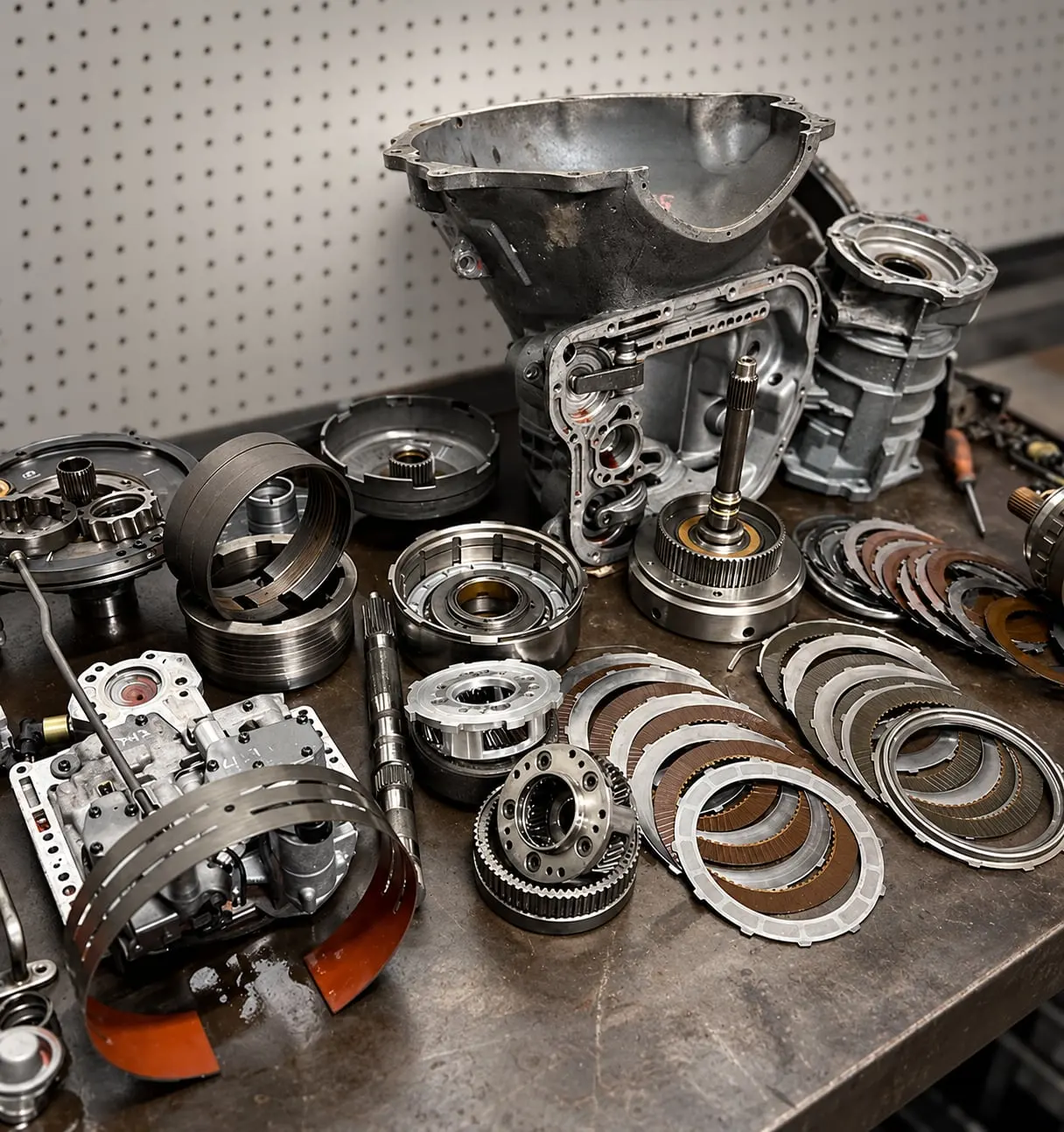
On the bench we handle the Ford 10R140, 6R140 and 5R110W, the Ram 68RFE and Aisin, the Allison units behind the Duramax and the medium-duty Allisons in trucks, buses and motorhomes. Ford IDS and WiTECH let us read commanded versus actual gear, converter slip, solenoid status and adaptive data, and the digital inspection shows you photos of what we found before you decide. Labor carries our 3-year / 36,000-mile warranty. For the full process, see truck transmission repair and rebuild. Engine trouble often rides along with shifting trouble on a towing truck, so our Lecanto truck repair page is worth a look, and the Citrus Hills transmission repair page covers the longer drive from there.