
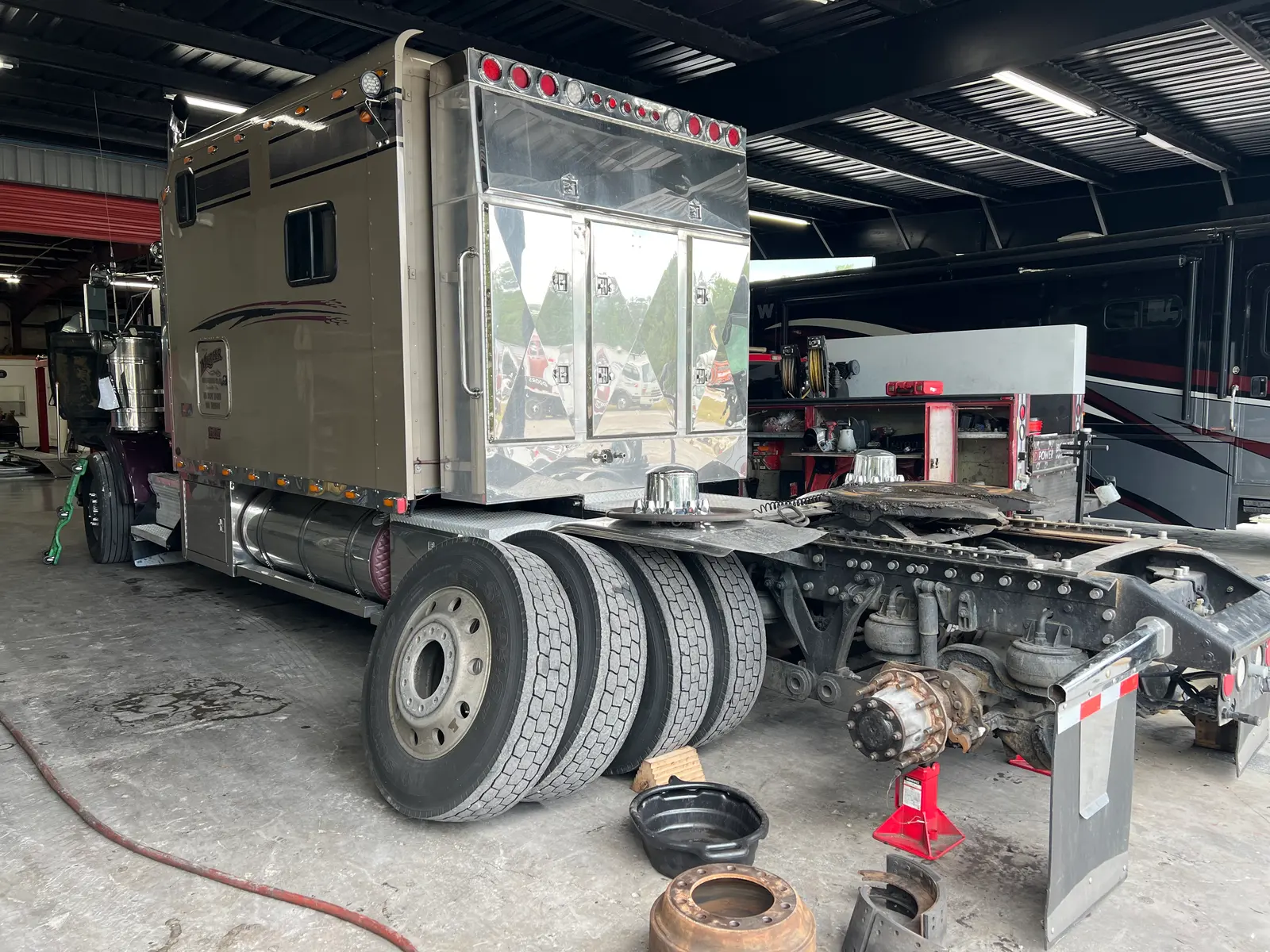
Tires keep a record of every alignment problem a truck has. Read them early and the fix is an adjustment; read them late and it is an adjustment plus a set of tires. RDI Power aligns pickups, vans, medium-duty trucks, tractors and motorhomes at our shop on Donto Way, about 19 minutes from North Weeki Wachee by Commercial Way and Cortez Boulevard.
Reading the tires on a North Weeki Wachee truck
Before you book anything, look at the front tires in good light and run a hand across the tread:
- Feathered edges, sharp in one direction and smooth in the other, usually mean toe is off. Toe is the setting that wears tires fastest.
- One shoulder worn down, inside or outside, points to camber or to a worn part letting the wheel lean.
- Cupping or scalloping around the tire is usually a shock, balance or bent-wheel issue, not alignment.
- Center wear or both edges worn is about inflation, not angles.
- Steer tires wearing faster than drives on a heavy truck can mean a drive axle is out of square, pushing the steer axle to fight it.
Drift, pull and a crooked wheel on US-19
Not every drift is the truck. Most roads are crowned for drainage, so a vehicle naturally eases toward the shoulder, and a truck that only drifts on one road may be fine. A real pull persists on flat pavement. Before blaming alignment, we check tire pressures, look for a dragging brake caliper and consider a tire with an internal problem, any of which can pull as hard as a bad camber setting. A steering wheel that sits off center when the truck tracks straight usually means toe or rear thrust is off, or that a steering part got bent.
Steering parts before angles for North Weeki Wachee trucks
An alignment on worn parts does not hold, so the inspection comes first. On Ford and Ram 4x4 heavy-duty pickups with solid front axles, the track bar, tie rod ends and ball joints get checked for play; wear there can cause a violent shake after a bump at speed, and a new steering stabilizer only hides it. Independent front ends get the same scrutiny at the idler arm, pitman arm and steering gear. Heavy trucks get kingpins, drag links and tie rod ends checked. Any worn part shows up in the digital inspection with a photo before you approve the repair.
Heavy trucks and coaches from the US-19 corridor
Big trucks need more than a front-end alignment. On a tandem-axle tractor or dump truck, the drive axles have to be square to the frame and parallel to each other, or every tire on the truck pays for it. Motorhomes carry heavy front axles on long wheelbases, where a small toe error adds up quickly over a trip. Chassis cabs and vans that ride heavy every day can sag, and lower ride height changes the angles, so we check springs and ride height along with the settings. If brakes, suspension or engine work are part of the picture, North Weeki Wachee semi truck repair covers the heavy side.
North Weeki Wachee trucks on the alignment rack
The drive in from North Weeki Wachee doubles as a road test: notice whether the truck pulls on Cortez Boulevard, where the wheel sits, and whether it wanders at speed, then tell us. At the shop, the truck gets a short road test, tire pressures set, the steering and suspension inspected, and then toe, camber, caster and thrust measured and adjusted within what the design allows. A final road test confirms the wheel sits straight and the complaint is gone. Our article on the benefits of wheel alignment covers what a proper alignment pays back.
For more on aligning every class of truck, see truck wheel alignment. Owners just south on US-19 can read Timber Pines truck alignment. To book a rack slot, call (352) 433-3800.