
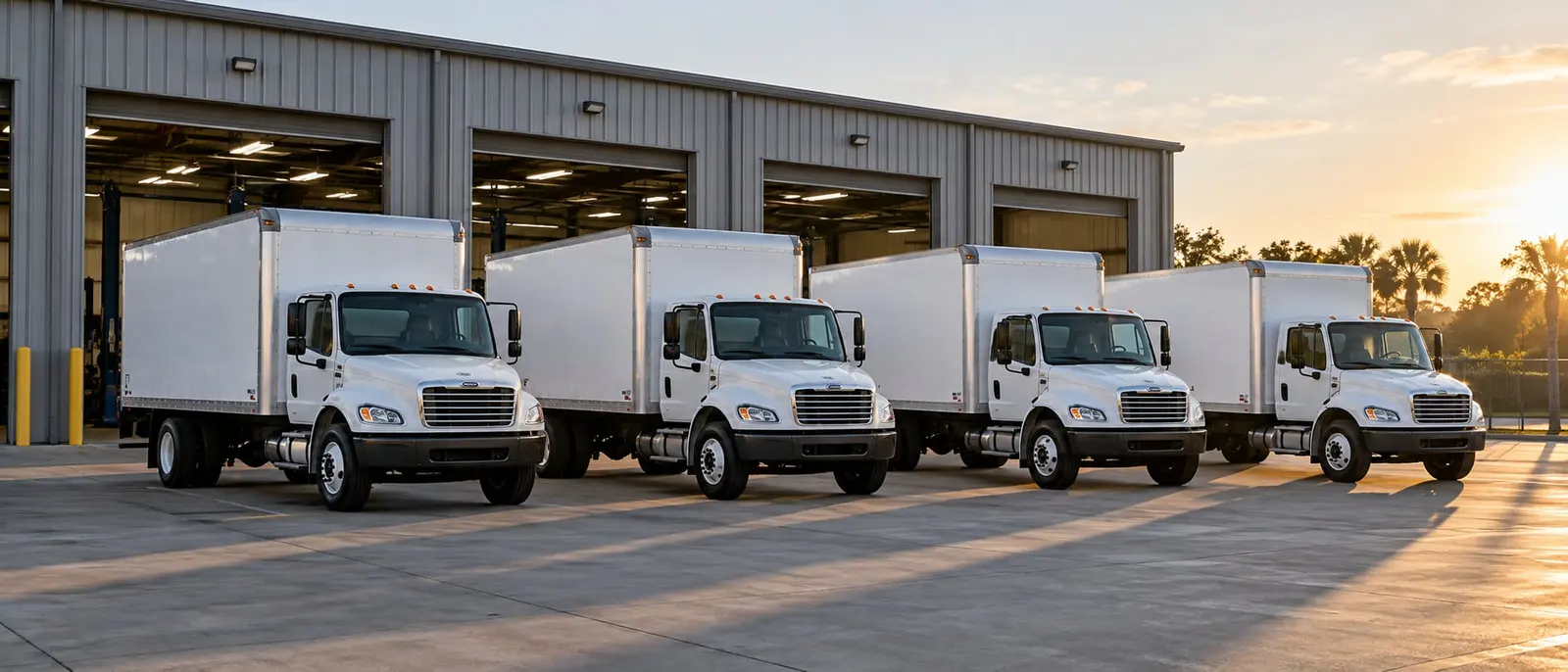
Contractors, landscapers, delivery services and utility crews all have reasons to work in a community of 12,668 residents and 7,838 housing units, where 80.8% of residents were 65 or older at the 2020 census. It is a residential community rather than a freight hub, and a fleet that works there is built for service work. If your business runs some of those trucks here, about 11 miles southwest of Ocala, RDI Fleet is our way of keeping them on schedule. The plan is written around your units, the routine work happens on your lot, and every truck and trailer gets its own illustrated report each time a technician from Brooksville looks it over.
The work trucks behind On Top of the World
A service fleet in a residential community seldom resembles a freight yard. It tends to be diesel pickups towing equipment trailers, box trucks on delivery runs, service bodies loaded with parts and tools, and now and then a dump truck on a construction job. Inside the community those trucks cover few miles but log long hours: rolling from stop to stop, idling while a crew works, restarting dozens of times. Then they pull onto SR 200, where FDOT’s 2025 count found roughly 7,371 trucks a day near the community, better than a quarter of the traffic.
That pattern punishes a specific set of parts, and the plan is built to watch them. Pickups that tow a loaded equipment trailer all day get their brakes, transmission fluid and cooling system checked first, because heat and weight show up there before anywhere else.
Trailers and hitch gear in an On Top of the World fleet
For many crews, the trailer matters as much as the truck. A trailer with dead lights or worn brakes sidelines the truck just as surely as an engine fault. An RDI Fleet plan treats each trailer as its own unit:
- Lights and wiring. Every circuit tested, corroded connections and damaged plugs repaired.
- Brakes. Electric or surge brakes checked and adjusted, with breakaway systems tested.
- Tires and bearings. Tread, pressure, sidewall damage and wheel bearing play.
- Couplers, chains and jacks. Wear, cracks and secure attachment.
Our trailer repair page covers the heavier trailer work, from axles to air brakes.
Setting intervals for On Top of the World crew trucks
A pickup that idles for half its working day can need oil service long before its odometer says so. We set each truck’s interval by engine hours, calendar time or miles, whichever reflects its actual work, and adjust as the inspections come back. Every PM visit covers fluids and filters, the cooling system, belts and hoses, brakes with lining measurements, tires, steering and suspension, batteries and charging, and a scan for fault codes, with regeneration history pulled on trucks with a DPF. Power Stroke, Duramax and Cummins pickups all get dealer-level diagnostics where it matters, including Ford IDS and WiTECH.
Lot visits planned around an On Top of the World crew schedule
Crews that start early and finish by midafternoon leave their trucks parked for the rest of the day, and that is when a technician can do the most good. We agree on the days and the hours, then service the whole group, trailers included, during a single stop. Anything heavier, an engine or transmission job or a repair that needs a lift, is scheduled into our Brooksville bays, and fleet units get first call on the schedule there.
Reports, warranty and after-hours help for On Top of the World fleets
The individual reports add up to something useful: a running history of what each truck and trailer needed, what it cost and what comes next, which turns budget season into arithmetic instead of guesswork. Work performed on an RDI Fleet account is backed for 24,000 miles or 2 years, and a fleet truck that quits on SR 200 in the evening is still covered, because roadside help for fleet accounts never clocks out.
A one-time breakdown is handled under On Top of the World mobile diesel repair. Across I-75 to the southeast, our Marion Oaks fleet maintenance page covers fleets on the CR 484 corridor, and RDI Fleet maintenance describes the program from first call to first PM. Phone (352) 433-3800 and tell us about your trucks and trailers.