
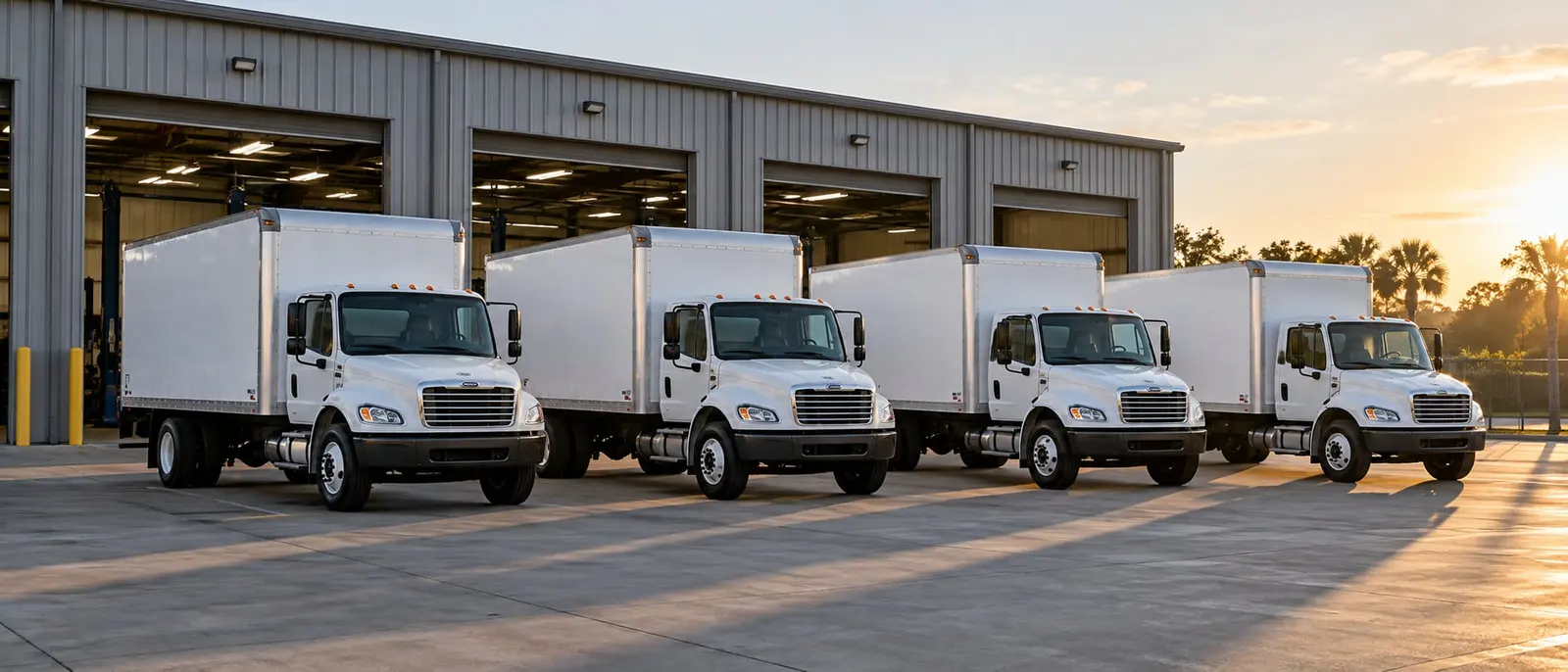
Orlando’s biggest public fleets run their own garages. Orange County Public Schools keeps more than 1,600 district vehicles at 4 garage facilities, and the LYNX Operations Center off John Young Parkway handles maintenance and storage for about 85% of LYNX routes. A smaller private operator may have nothing like that, just a yard, some trucks and a person juggling maintenance between everything else. RDI Fleet, the fleet program run by RDI Power, is built for those operations.
Orlando fleets without their own garage
RDI Fleet is not a separate company. It is how RDI Power organizes work for fleet accounts: a maintenance plan written around your operation, budget, fleet size and vehicle types, scheduled preventive maintenance, priority service when something breaks, digital inspection reports on every visit, a 2-year / 24,000-mile warranty on fleet repairs and 24/7 roadside assistance. In Orlando, far from our Brooksville bays, nearly all of it happens at your location. Our technicians come out from Brooksville with diagnostic tools and on-site repair capability.
A yard day in Orlando, planned from Brooksville
Because every visit starts with the run east from our shop on SR-50 and the Turnpike, Orlando yard days are booked ahead and grouped. One visit can cover PM on several units, an annual inspection or 2 and the small repairs that last month’s reports flagged. To make that work:
- Send the unit list early. Year, make, engine, mileage or hours, and any driver complaints, so parts and filters arrive with the technician.
- Pick the window. Visits are scheduled around your operation, ideally when the trucks would be parked anyway.
- Clear the gate. A contact on site, keys and a firm, level spot to work make the day go faster.
Intervals for Beachline miles, airport idling and Lake Nona sites
An Orlando fleet may run several duty cycles at once. FDOT counts about 24,361 trucks a day on the western Beachline, where a tractor can pile up highway miles fast, and that kind of work usually supports mileage-based PM. A box truck shuttling around the airport area, stopping, idling and starting all day, ages by engine hours instead. And Lake Nona’s growth, from 1,500 residents in 2000 to more than 50,000 by 2015, keeps construction traffic steady; on a construction site, PTO time and dust matter more than the odometer.
So each class gets its own schedule inside the same plan:
- Light duty pickups and vans: the manufacturer’s schedule, shortened for heavy towing, idling and short trips.
- Medium duty vocational trucks: hours as much as miles, with PTO time counted.
- Highway tractors: mostly mileage-based.
- Trailers: brakes, bearings, lights and tires on their own clock, timed with the tractor’s visit when the pair runs together.
Whatever the interval, a PM at an Orlando yard runs the same checklist: fresh oil and filters, fuel filters and the water separator, coolant, belts and hoses, brake linings measured, tires gauged, lights and batteries tested, and a scan for stored and pending codes. Aftertreatment gets attention on every unit too. Low-speed, high-idle work is hard on DPF and EGR systems, and catching a loading filter at the yard beats a derate on SR-417.
Annual inspections on an Orlando fleet calendar
Interstate commercial vehicles that cross the 10,001-pound GVWR mark need an annual inspection, and the report has to stay on file for 14 months. On an RDI Fleet account, each unit’s annual is booked with its PM so the truck comes out of service once for both. Drivers still own the daily pre-trip; the plan covers everything around it. Our DOT inspections page explains what the annual covers.
Reports an Orlando fleet manager can use
The technician documents each unit in a digital vehicle inspection, pairing every finding with a photo and a note and sorting them into what needs attention now and what can wait for the next visit. Over months, that becomes a service history for each unit, which turns budgeting into arithmetic and makes the repair-or-replace question easier to answer with evidence.
Getting an Orlando fleet onto RDI Fleet
Onboarding is practical work, and most of it happens in your yard:
- A first call. How many units, which classes, where they park, what they do and what keeps failing.
- A walk-around. A technician inventories each unit by VIN, engine, mileage or hours and condition, and flags anything with an open problem.
- Intervals and dates. Using that inventory, the manufacturer’s schedules and your duty cycles, we set PM intervals class by class and line up every annual inspection.
- A shared calendar. You see what is due and when, and the first scheduled yard day goes on the books.
A clean unit list helps, but nobody needs one to begin; the walk-around produces it.
Priority, warranty and roadside across Orlando’s toll roads
When a fleet truck breaks, it goes ahead of non-fleet work in our queue, and the person on the phone already has that unit’s records. Fleet repairs carry a 2-year / 24,000-mile warranty. If a unit stops at night on the Beachline or SR-417, the 24/7 roadside coverage applies; we will give you a straight answer on timing rather than a promise. Lift work, from an in-frame overhaul to a transmission rebuild, comes to Brooksville on a date we set together.
To see the full program, start with RDI Fleet maintenance. For breakdown help without a plan, see mobile diesel repair in Orlando, and fleets based south of the airport can compare notes on the Meadow Woods fleet maintenance page. A first call to (352) 433-3800 with your unit list is enough to get a plan started.