
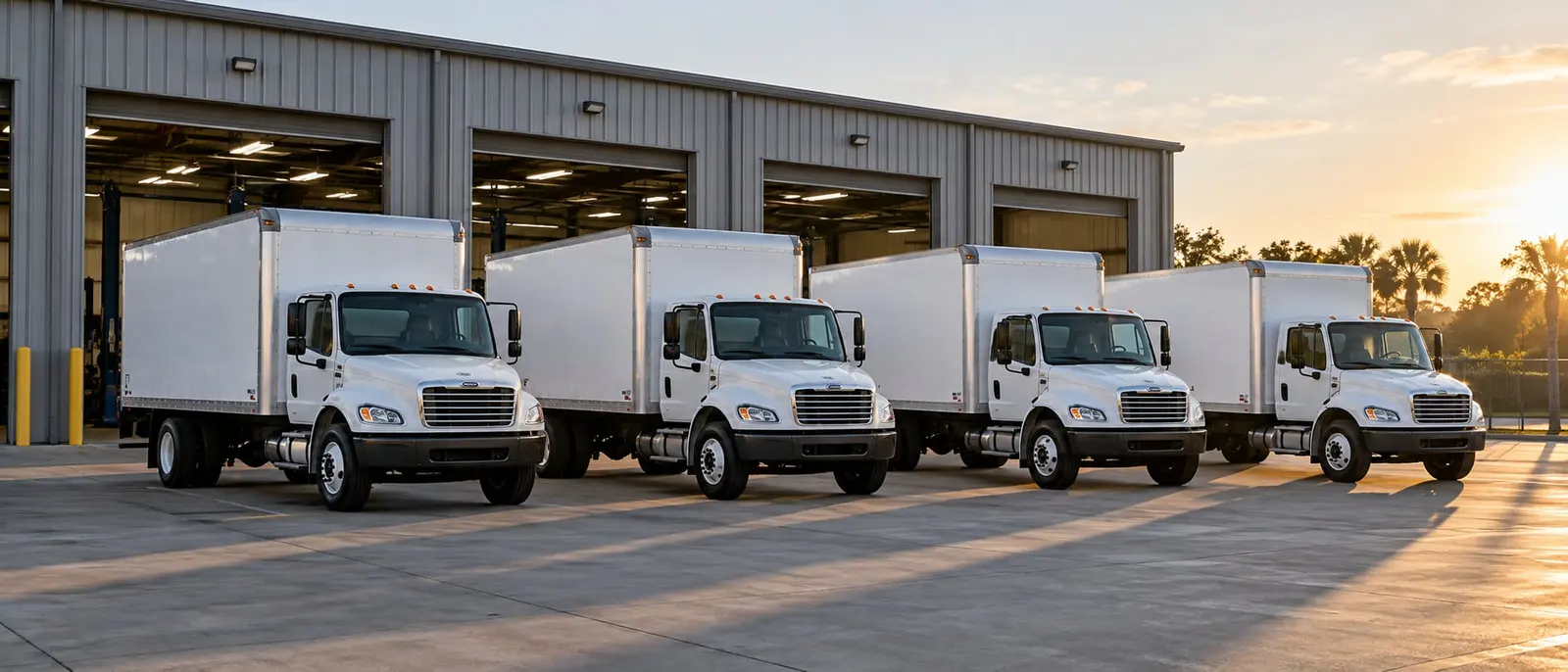
Starke has been doing things first for a long time. Its electric utility, founded in 1890, was Florida’s first public power utility, and US 301 through town has long been the quickest road between Jacksonville and Tampa, with CSX’s Wildwood Subdivision main line running through the county alongside it. Camp Blanding, the Florida National Guard’s main training base, uses a Starke mailing address, and three state prisons sit about 10 miles away. RDI Fleet is RDI Power’s fleet program. We have no branch in Starke; it is close to the outer edge of the area our Brooksville technicians cover, and that distance is the best argument for a plan over waiting for breakdowns.
Through freight and local work in a Starke fleet
Bradford County is a Foreign Trade Zone and a Rural Area of Opportunity, Waste Management and GFL both serve it, and strawberries remain an important crop, celebrated each April at the Bradford County Strawberry Festival. A fleet based here could include almost anything: tractors running US 301, roll-offs and collection trucks, farm trucks, contractor pickups and trailers. Whatever the mix, the units do different work, and a plan written for one kind of truck will short-change the others.
Intervals for Starke tractors that live on US 301
A tractor that spends its days at highway speed on US 301 piles up miles steadily and evenly, which suits a mileage-based interval drawn from the engine maker’s schedule. Its inspections focus on what highway miles wear out: tires, brakes, wheel ends, the cooling system and the aftertreatment that has to regenerate on the move. A local truck in the same yard may idle for hours, run a PTO or make short hops, and its odometer understates how hard the engine has worked, so we use engine hours or calendar time instead. Trailers get their own schedule for brakes, lights, wiring, tires and bearings. Each class is inspected for what its own duty cycle wears out.
Scheduling RDI Fleet visits at the edge of our range in Starke
Distance changes how we plan, not whether we come. Instead of sending a technician up for one unit at a time, we look at the calendar for your whole yard and group the trucks and trailers that come due within the same window into a single weekday visit, booked weeks ahead for days your units are parked. Annual inspections are folded into those same visits, so a unit comes out of service once for PM and inspection together. If your work has a busy season, such as strawberry harvest for a grower’s trucks, we load the PM into the weeks before it. Major engine and transmission jobs come to the Brooksville shop on a date you choose, with the move planned so you can cover the route. Fleet accounts get priority service when something fails between visits.
A Starke yard visit, start to finish
On the day, the technician checks in with your contact and confirms which units are due. Each one gets its scheduled service: fluids and filters, a brake and air system check, tires and wheel ends, belts, hoses and coolant, lights and wiring, batteries and charging, aftertreatment and a code scan. Anything that turns up beyond the plan is photographed and sent to you for approval before the work starts, so nothing gets added to the bill without your say. Small repairs are often finished the same visit. Before the service truck leaves Starke, every unit has a report waiting for you.
How a Starke plan gets started
First, a phone conversation about what you run, how it works and what keeps failing. Then a walk-around at your Starke yard: a technician records each unit’s engine, odometer or hour meter, condition and job, and flags anything with an open problem so it is fixed before the schedule begins. From that inventory and the manufacturers’ recommendations, we set intervals, line up inspection due dates and send you a calendar. A clean unit list helps, but it is not required; building one is part of the walk-around.
Starke reporting, warranty and 24/7 fleet roadside
Every service leaves a digital inspection report for each unit, with photos and the technician’s notes, and findings separated into what needs attention now and what can be planned. Kept over time, those reports become a maintenance history you can budget from and defend in an audit. Repairs under the fleet program carry a warranty of 2 years / 24,000 miles. Roadside help for fleet accounts runs at all hours, which matters on a freight corridor where trucks move through the night.
When a truck needs help before it is on a plan, see Starke mobile diesel repair. East on SR 100, our Palatka fleet maintenance page covers plans for mill and port fleets, and the program is described in full under RDI Fleet maintenance. A call to (352) 433-3800 is how your Starke plan begins.