
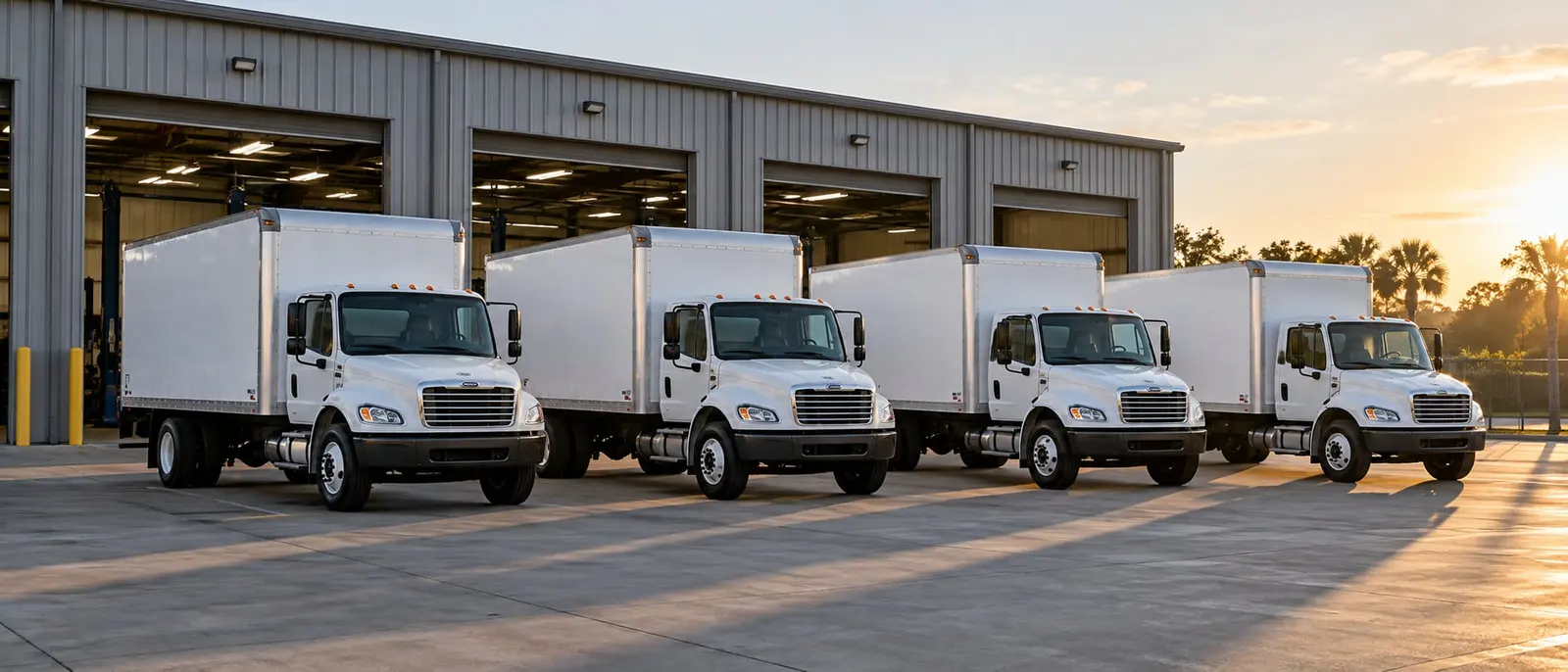
Gainesville’s largest employers are institutions. The city’s 2023 financial report puts the University of Florida, UF Health Shands Hospital, the Alachua County School Board, the VA and the City of Gainesville at the top of the list, and much of what moves on its streets has the same civic character: transit buses, service vans, contractor trucks and waste haulers working short routes in heavy traffic. RDI Fleet is the fleet program of RDI Power, built for operators who would rather plan that maintenance than react to it. We have no Gainesville location. Technicians come to your yard from Brooksville on a schedule agreed with you.
Lessons from Gainesville’s aging transit buses
Gainesville’s Regional Transit System, which Wikipedia describes as Florida’s fourth-largest, reported 148 buses in 2023: 139 diesel and 5 diesel hybrids. Its own transit development plan notes that nearly 38% of those buses were past their 14-year useful life, and the agency maintains them at a 20.5-acre facility on SE 13th Road with bus bays, a wash and its own fueling.
Few private operators have a building like that, but the lesson carries over. Diesels kept in service past their planned life can stay productive, and they need closer attention than new units: inspections on a tighter cycle, cooling and charging systems tested before they fail, brake and suspension wear measured on a schedule rather than discovered at the curb. An RDI Fleet plan gives a smaller fleet that discipline without the building.
Haulers and delivery trucks working Gainesville
Not every Gainesville fleet is public. Commercial haulers feed the county transfer station on NE 63rd Avenue and its rural collection centers on Waldo Road, SR 121 and Hawthorne Road, and the Greater Gainesville Chamber names distribution and trade (warehouses, freight trucking and wholesale) among the region’s focus industries. Those duty cycles wear equipment in different ways. A collection truck works its brakes, hydraulics and cooling system on every stop, while a delivery box truck racks up idle time at docks and curbs. A plan should reflect that difference rather than run every unit on one calendar.
Building a Gainesville RDI Fleet plan unit by unit
Every plan begins with an inventory. For each unit we record year, make, engine, mileage or hours, condition and what it does all day, then agree with you on how it should be maintained:
- What triggers service. A van crawling through campus traffic piles up idle hours faster than miles, so hours often make the better trigger. A tractor that leaves town on I-75 every morning is better served by mileage.
- When service lands. If your work follows the university calendar or another busy stretch of the year, preventive maintenance gets booked ahead of it, not in the middle of it.
- What it costs. You get a straight answer on what needs doing now, what can wait for next quarter and what only needs watching.
- What classes it covers. Light duty pickups and Sprinter vans, medium duty box trucks, heavy tractors, trailers and buses can all sit on one plan, each with intervals that suit it.
Yard service across Gainesville
Most preventive maintenance can happen where Gainesville trucks park overnight: oil and filters, fuel filters and water separator service, chassis lube, belts and hoses, brake lining measurements, tire checks and a scan for stored and pending codes. Doing that in your lot means a driver does not lose half a shift ferrying a truck to a shop. Work that needs a lift or a teardown, such as major engine or transmission repair, comes to the Brooksville bays, and we schedule that move around your slowest days.
Fleet accounts also get priority when something unplanned breaks, and whoever takes the call already has the unit’s history in front of them. If a single Gainesville truck needs a one-time repair rather than a plan, our Gainesville mobile diesel repair page covers on-site breakdown service.
Annual inspections for Gainesville trucks, trailers and buses
Federal rules require an annual inspection for commercial vehicles of 10,001 pounds GVWR or more that operate interstate, and the carrier keeps that report for 14 months. On an RDI Fleet plan, each unit’s inspection date shares a calendar with its PM, so it leaves the road once for both. Anything that fails is photographed and written up for your approval before repairs begin. The daily pre-trip check still belongs to the driver; a plan supports it and never replaces it. Our DOT inspections page details what the annual covers.
Records, warranty and 24/7 roadside for Gainesville accounts
Each visit closes with a digital vehicle inspection filed under that unit, with photos of every finding and the technician’s notes. After a year of those, it becomes clear which trucks are worth repairing and which are costing more than they earn. Repairs under an RDI Fleet account carry a 2-year / 24,000-mile fleet warranty, and fleet customers have 24/7 roadside assistance, which matters for units that run I-75 or SR 331 after dark.
West of the city, our Newberry fleet maintenance page covers how plans work for a smaller town’s mixed yards. The full program is laid out under RDI Fleet maintenance. Call (352) 433-3800 with a unit list, even a rough one, and we will show you what a Gainesville plan looks like.