
Around Groveland, very different diesel duty cycles share the same few roads. Lake County’s largest existing industrial park, the Christopher C. Ford Commerce Park at the US 27, SR 19 and Turnpike crossroads, holds trucking, food distribution, bottling and e-commerce tenants. Two private haulers collect the city’s garbage: Waste Connections on residential routes and WCA Waste, under a contract dating to October 5, 2020, on commercial ones. A palm and tree farm on Cherry Lake Road ships nursery stock with outside trucking vendors. And construction began in 2026 on the $25 million Villa City Water Treatment Plant, the city’s sixth. RDI Fleet, RDI Power’s fleet program, writes maintenance plans for exactly this kind of mix, and our technicians come out from Brooksville to carry them out.
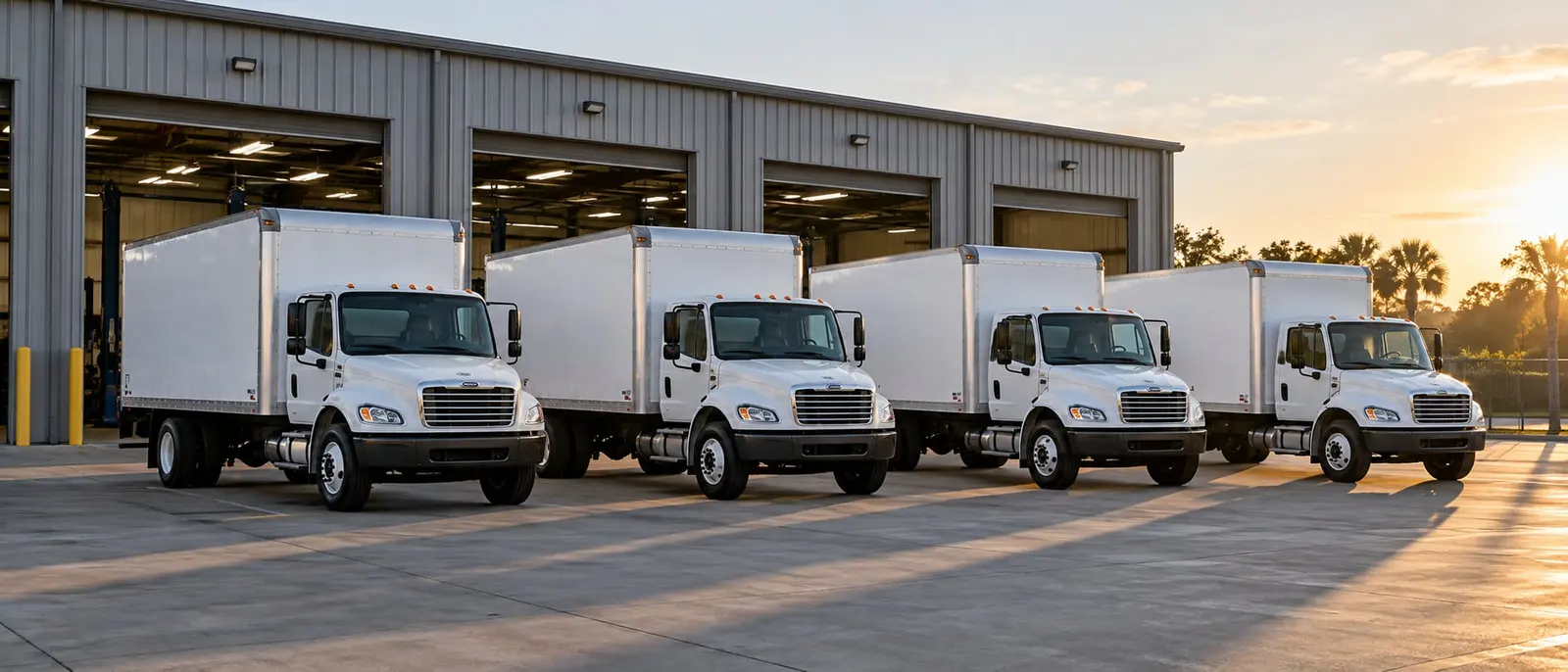
Last-mile vans and distribution trucks at the Groveland crossroads
An Amazon last-mile delivery station and a Kroger robotic fulfillment center opened at the commerce park in 2021, alongside distribution operations for Domino’s and Dunkin’ Donuts. Delivery work loads vehicles very differently from highway trucking. A van or box truck on a last-mile route stops and starts all day, so brakes, starters, batteries and door hardware wear faster than the mileage suggests, while a distribution tractor running regional routes stacks up steady miles.
If part of your fleet works either pattern, RDI Fleet sets each class on its own schedule: stop-and-go units by engine hours or calendar, highway units by miles, both starting from the manufacturer’s recommendations. For diesel vans specifically, our Sprinter van page covers what those chassis need.
Heavy freight from the Groveland bottling and distribution tenants
Bottled water is dense freight. A tractor-trailer loaded with it, like one loaded with food for a distribution center, can run near its legal weight limit, and that shows up in specific places: brake linings and drums, tires, wheel bearings, suspension bushings and the fifth wheel. Weight also loads the cooling system on every climb and every stop in Florida heat. For heavy-haul units around the Exit 285 crossroads, RDI Fleet measures brakes and tire tread at each visit, checks wheel ends for play and seepage, and pressure-tests the cooling system on a schedule instead of waiting for a hose to let go.
Refuse trucks on Groveland’s collection routes
Refuse trucks are among the hardest-working diesels in any town: heavy loads, a stop at nearly every driveway, a hydraulic packer running off the engine and long stretches at idle. Brakes take a beating, and so do the cooling and charging systems. Low-speed work also keeps exhaust temperatures down, which makes DPF loading a recurring issue.
If you run collection trucks, roll-offs or similar heavy vocational units around Groveland, plan them on engine hours with brake linings measured at every visit, cooling system pressure-tested on a schedule, and regeneration history reviewed each time the truck is scanned. Catching a dragging brake or a weak fan clutch in the yard is a lot cheaper than finding it halfway through a route.
Palm and tree hauling out of Groveland nurseries
Hauling nursery stock means flatbeds and trailers with tie-downs, trailer brakes, lights and tires under constant strain, often running between farm roads and highways in the same trip. Cherrylake alone grows 550 acres of palms and works with outside carriers. Haulers that serve farms like it need trailers on the same maintenance calendar as the tractors pulling them: brakes and wheel bearings checked, lights and wiring tested at the plug, tires inspected for tread and sidewall damage. See trailer repair for the trailer side of that work.
Building a Groveland PM calendar around delivery windows
Technicians from Brooksville come to your yard on planned dates, timed for when units are parked. A fleet that loads early and returns by mid-afternoon might get its visits in the middle of the day; one that runs nights can have its trucks serviced during the shop’s daytime hours. Each visit covers PM, a fault code scan and inspection on every unit, and the small repairs found along the way. Larger jobs go to the Brooksville shop, where fleet accounts get priority.
Annual inspections fall on the same day as PM, so a unit comes out of service once. Federal rules require that inspection every year for interstate commercial vehicles of 10,001 lb GVWR or more, and the report has to be kept for 14 months.
After-hours cover for Groveland units on SR 50
A unit that quits at night on SR 50 through the redevelopment area, on SR 19 or on the Turnpike is covered by RDI Fleet’s round-the-clock roadside help. Repairs under the program are backed for 2 years or 24,000 miles, and each visit’s photos and notes join that unit’s file, which is where next year’s repair budget comes from.
How a breakdown between visits gets handled is explained on Groveland mobile diesel repair. For onboarding, see RDI Fleet maintenance; operators on the Turnpike corridor can also compare Minneola fleet maintenance. Start with a call to (352) 433-3800.