
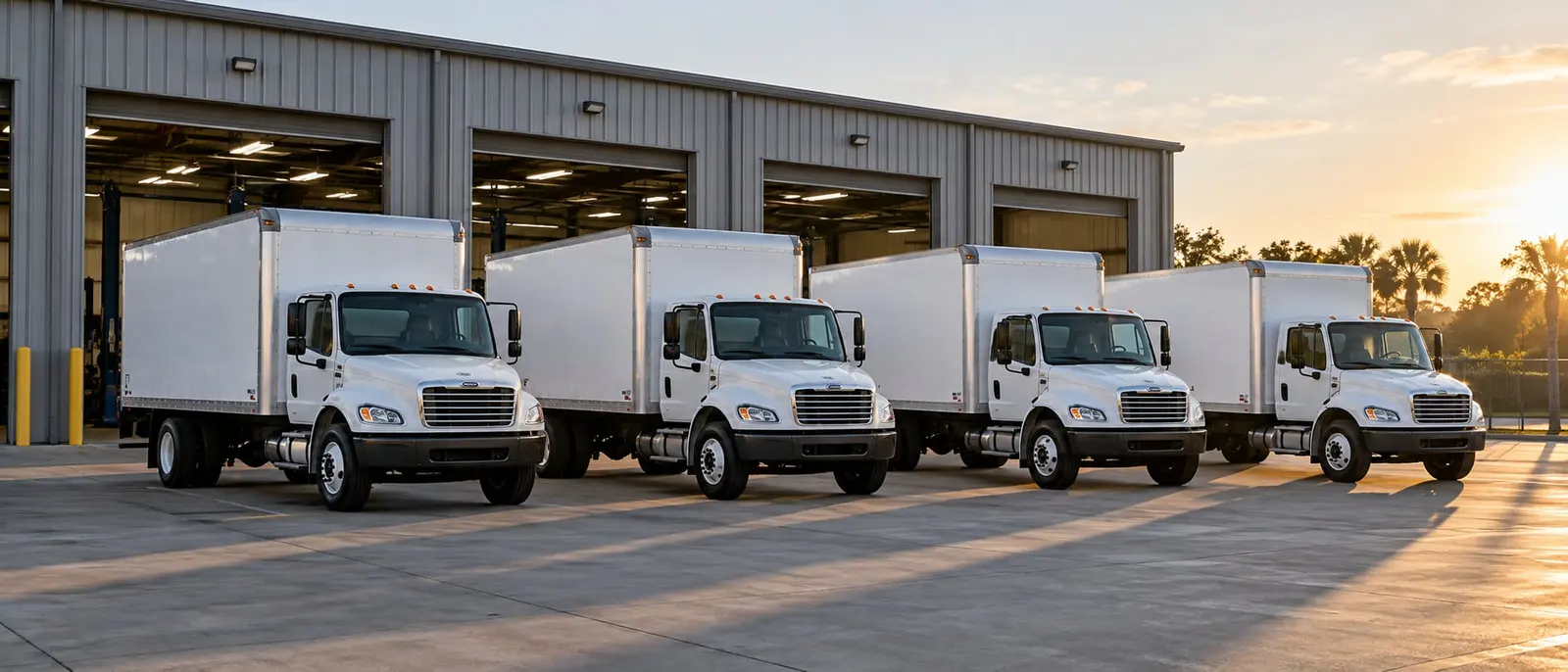
Timber work starts on dirt and ends on the highway. A log truck leaves a landing on a sand or clay woods road, then runs loaded on US-19, US-41 or I-75 to a mill. That combination, off-road abuse followed by highway miles at full weight, is hard on a truck in ways a highway tractor never sees. RDI Power maintains and repairs forestry trucks across Hernando, Citrus and Pasco counties from our Brooksville shop and on-site.
Trucks a forestry operation runs
- Log trucks, some with a self-loading knuckle boom
- Tractors pulling log and pole trailers
- Chip vans and chip trucks
- Lowboys moving skidders, feller bunchers and loaders between tracts
- Service and fuel trucks working the landing
- Crew pickups
Most run Cummins, Detroit or Caterpillar engines on Freightliner, Peterbilt, Kenworth, Mack, International or Western Star chassis. See heavy-duty truck repair.
Where forestry trucks break
Woods roads
Ruts, stumps, washouts and washboard pound springs, hangers, torque rods, shocks and frames. Spring leaves crack, bushings wear out and frames crack near crossmembers and hangers. A truck that rides rough unloaded is telling you something about its suspension. See shocks and suspension.
Sand, bark and needles
Debris from the woods packs radiators and charge air coolers until the engine cannot shed heat. Sand works into brake drums, S-cam bushings and slack adjusters and wears them early. Cleaning the cooling stack is a regular service item on a log truck, not an afterthought. See radiators and cooling.
Air system
Bouncing over rough ground loosens fittings and flexes air lines until they chafe through. A slow leak shows up as a compressor that never stops working and, eventually, brakes that will not release. See brake systems.
Fifth wheels and coupling
Loaded log trailers put heavy, uneven loads through the fifth wheel on rough ground. Worn jaws, slack in the lock, dry plates and cracked mounting brackets are the kind of thing that passes a quick glance and fails a close inspection. We check fifth wheel lockup, wear and mounting at every PM, and grease it while we are there.
Tires
Stumps and limbs cut sidewalls, and a cut that looks small in the woods can fail at highway speed under a full load.
Electrical
Trailer lights and wiring on log trailers take hits from limbs, mud and loading. Broken lamps and torn harnesses are routine findings.
Keeping a timber fleet on the road
An RDI Fleet plan for a forestry operation puts the inspection where the damage happens:
- Suspension, frame and air system inspected at every PM, not just fluids and filters
- Cooling stack cleaning on an interval that matches the debris load
- On-site service at your yard through mobile diesel repair, so a sick truck is fixed where it sits instead of burning a hauling day on the way to a shop
- Annual DOT inspections for trucks and trailers, where brakes, frames and coupling devices get the closest look
- Digital inspection photos of frame cracks and worn suspension parts, so repairs can be planned around the cutting schedule
- Trailer running gear checked during the same visit. See trailer repair
Why downtime matters in the woods
Logging runs on a cycle: cut, skid, load, haul. When the truck is down, wood piles up at the landing, the crew runs out of room to work, and the mill’s delivery schedule slips. A contract hauler with a truck in the shop is a hauler without income for the day, and a crew without a truck is a crew standing around. Most of the failures that cause that are visible in an inspection long before they stop a truck.
Keep the wood moving
Tell us how many trucks and trailers you run and where they work. We will set up maintenance that fits the woods roads, and come to your yard when a truck needs it.