
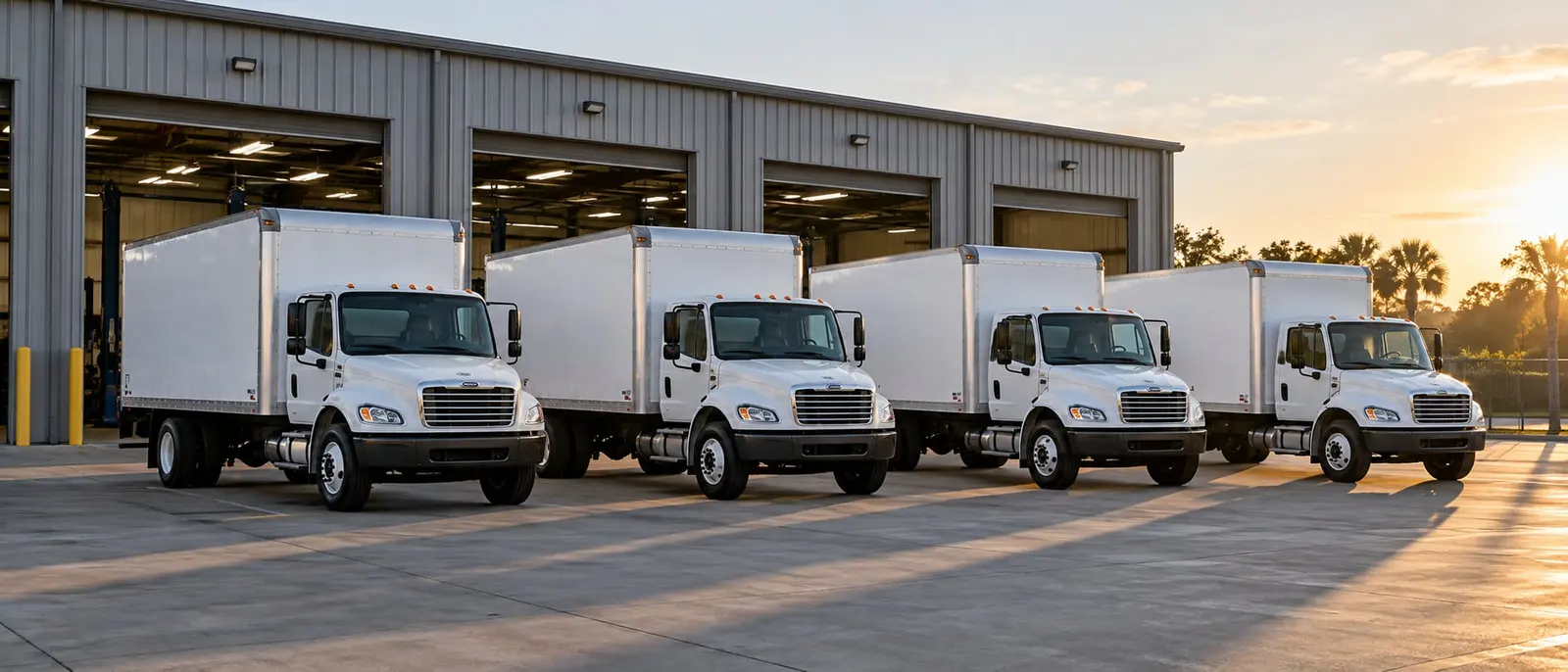
A century ago, Elfers shipped its citrus by rail. Today nothing moves here by train: the Seaboard Air Line branch that once ended in Elfers ran its last freight on December 24, 1986. If your operation runs vehicles out of Elfers, they share US 19 and SR 54 with every other truck on this side of the county, and they spend much of the day in traffic. RDI Fleet, RDI Power’s fleet program, gives operators here a maintenance plan built for that kind of work: scheduled preventive maintenance at your yard, repairs diagnosed to the root cause and a photo record of every unit.
Elfers fleets on the SR 54 and US 19 grid
FDOT’s 2025 counts give a sense of the traffic. About 6,344 trucks a day use US 19 near Elfers, roughly 10.4% of everything on the road. About 3,564 a day use SR 54 between Seven Springs Boulevard and Old Millpond Drive, where the highway starts as a 6-lane divided road at US 19. A delivery truck or service van working those corridors sees signal after signal, short runs between stops and long stretches of idle.
That is a hard life for a modern diesel. The parts it wears first are not always the ones a mileage-based schedule watches: brakes that stop the truck hundreds of times a shift, starters and batteries cycled with every delivery, and an exhaust system that rarely gets hot enough to look after itself.
Watching aftertreatment on Elfers trucks
The emissions systems on today’s diesels need heat and steady load to keep themselves clean. Stop-and-go driving provides neither. A diesel particulate filter that cannot burn off soot during normal driving depends on active regenerations, and a truck that shuts off in the middle of one starts over the next time. EGR valves and coolers collect soot in the same conditions. DEF systems throw faults when a sensor, a heater or a dosing valve starts to fail.
An RDI Fleet plan for Elfers trucks treats aftertreatment as a maintenance item, not a breakdown waiting to happen:
- Regeneration history at every visit. How often each unit regenerates, how many finish and how many are cut short.
- Sensor and differential pressure checks. Early signs of a loading DPF show up in the data before the dash light does.
- DEF system inspection. Fluid quality, dosing and heater function, plus the fault history.
- EGR attention. Codes and performance data reviewed so a sticking valve or a clogging cooler is planned for, not discovered on the side of SR 54.
Our article on DPF and regen problems in diesel trucks explains the warning signs in plain language.
How an RDI Fleet yard visit runs in Elfers
Visits are scheduled around your operation, on the days and hours your trucks are parked. When the technician arrives, the unit list for that visit is already set. Each vehicle gets the full PM checklist: oil and filters, fuel filters and water separator, air filter, cooling system, belts and hoses, brakes with lining measurements, tires, steering and suspension, lights, batteries and charging, and a scan for stored and pending codes. Air-braked trucks get adjustment and leak checks. Trailers get brakes, lights, tires and bearings.
Every finding is photographed and written up in a digital vehicle inspection, sorted into what needs attention now and what can be planned. Small repairs can often be done on the same visit. Bigger ones, such as major engine or transmission work, are booked into the Brooksville shop, where fleet accounts get priority, and we coordinate the timing so you are not short-handed.
Annual inspections fall into the same rhythm. A unit that needs its yearly federal inspection gets it during PM, and the report goes into its records.
Fleet warranty and after-hours coverage for Elfers units
Repairs on an RDI Fleet account are warrantied for 24,000 miles or 2 years. When an Elfers truck stops on US 19 at night, fleet customers have roadside help 24/7, from people who can see that truck’s history.
For one-off breakdowns, see mobile diesel repair in Elfers. Operators just north can read about fleet maintenance in New Port Richey, and the full program is on RDI Fleet maintenance. Call (352) 433-3800 to talk through what your trucks do all day.