
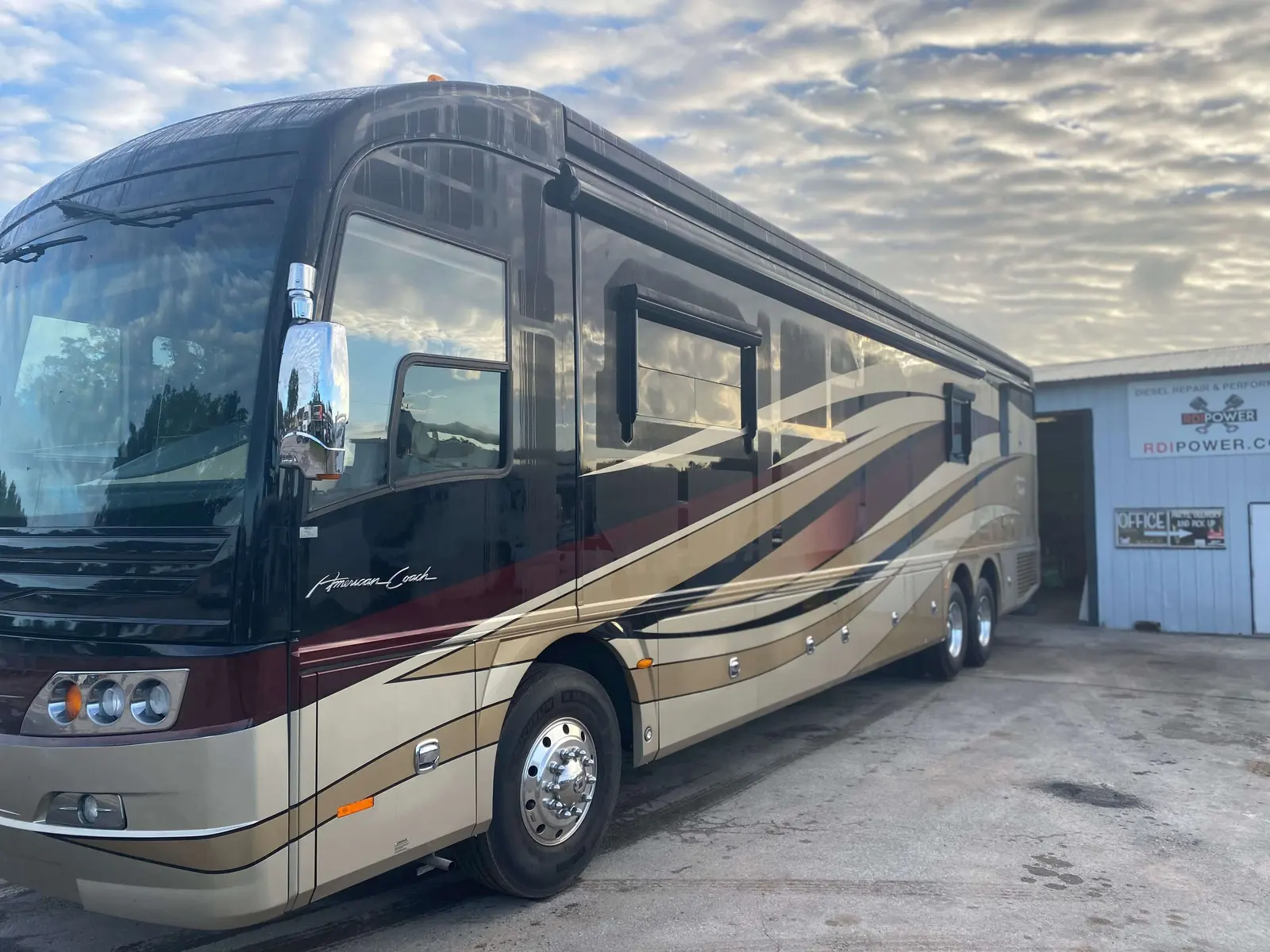
Our shop is a long run up I-75 from Wesley Chapel: about 36 road miles and roughly 50 minutes from the middle of the community. For a diesel pusher, that drive is more than a commute. It is a road test. At our Brooksville shop, RDI Power handles the running gear of a coach: the Cummins or Caterpillar diesel, the Allison behind it, the driveline, the air brakes and air suspension, the steering and the cooling system.
What the I-75 run from Wesley Chapel tells you about a coach
Pay attention on the way up, because the interstate brings out problems that a slow drive around the neighborhood hides:
- Temperature. A gauge that creeps above its usual spot at a steady 65 points to a cooling stack that is clogging, a weak fan drive or low coolant.
- Wander. A coach that needs constant steering corrections at speed may have worn steering linkage, a loose gearbox or tired suspension bushings.
- Vibration. A shake that comes and goes with road speed can be a driveshaft or U-joint, a tire or a wheel.
- Shifts. An Allison that hesitates, flares or holds a gear too long at highway speed deserves a scan before the next trip.
- Air. If the pressure gauges drop faster than normal after stops, or the compressor seems to run constantly, there is a leak or a tired component somewhere.
Make a note of when the symptom shows up and tell us when you book. That detail shortens the diagnosis.
Air brakes and air suspension on Wesley Chapel diesel pushers
The air system does 2 jobs on most pushers: it stops the coach and it holds the coach up. That makes leaks doubly important. We check how quickly the compressor builds pressure, whether the dryer purges and keeps moisture out of the tanks, how far each brake chamber strokes, and whether the slack adjusters are holding adjustment. On the suspension side, air bags crack with age and height control valves stick, and a coach that leans or sits low on one corner after it parks is telling you which side to look at. Brake work covers both air and hydraulic systems, and our brake systems page has the details.
Engine and Allison service for Wesley Chapel motorhomes
Most pushers carry a Cummins, Caterpillar or Detroit engine, and our shop holds Caterpillar certification. The engine side of the job runs from oil and filter service and fuel filters to injectors, turbochargers and derate diagnosis. A rear engine lives in heat, so hoses, belts and wiring back there age faster than they would in a truck, and radiators and charge air coolers mounted at the rear pull in road grime until the coach runs hot on a long pull. We clean and inspect the cooling stack before condemning a part.
The Allison gets the same evidence-first approach as any transmission: fluid level and condition, stored codes, then a road test with the scan tool connected. Many shift complaints end with fluid service, a sensor or a software update. Findings come back as photos and notes in your digital inspection, and the labor is backed for 3 years or 36,000 miles.
When a Wesley Chapel coach should stay parked
Leave the coach where it is if it is leaking coolant, showing low air, limping along in a single gear or shaking in a way it never has before. Each of those can turn expensive over 36 miles of interstate. A coach sitting at a campground, in a storage lot or on the shoulder can often get a technician sent to it for a diagnosis. When the shop is the answer, we help arrange a heavy wrecker, and the driver of that wrecker should hear up front that the engine is in the rear.
Our RV service and repair page lists everything we do on a coach chassis. Owners north of the outlets can read RV repair in Pasadena Hills, and those along US-41 can see RV repair in Land O’ Lakes. Call (352) 433-3800 and tell us what the coach did on its last drive.