
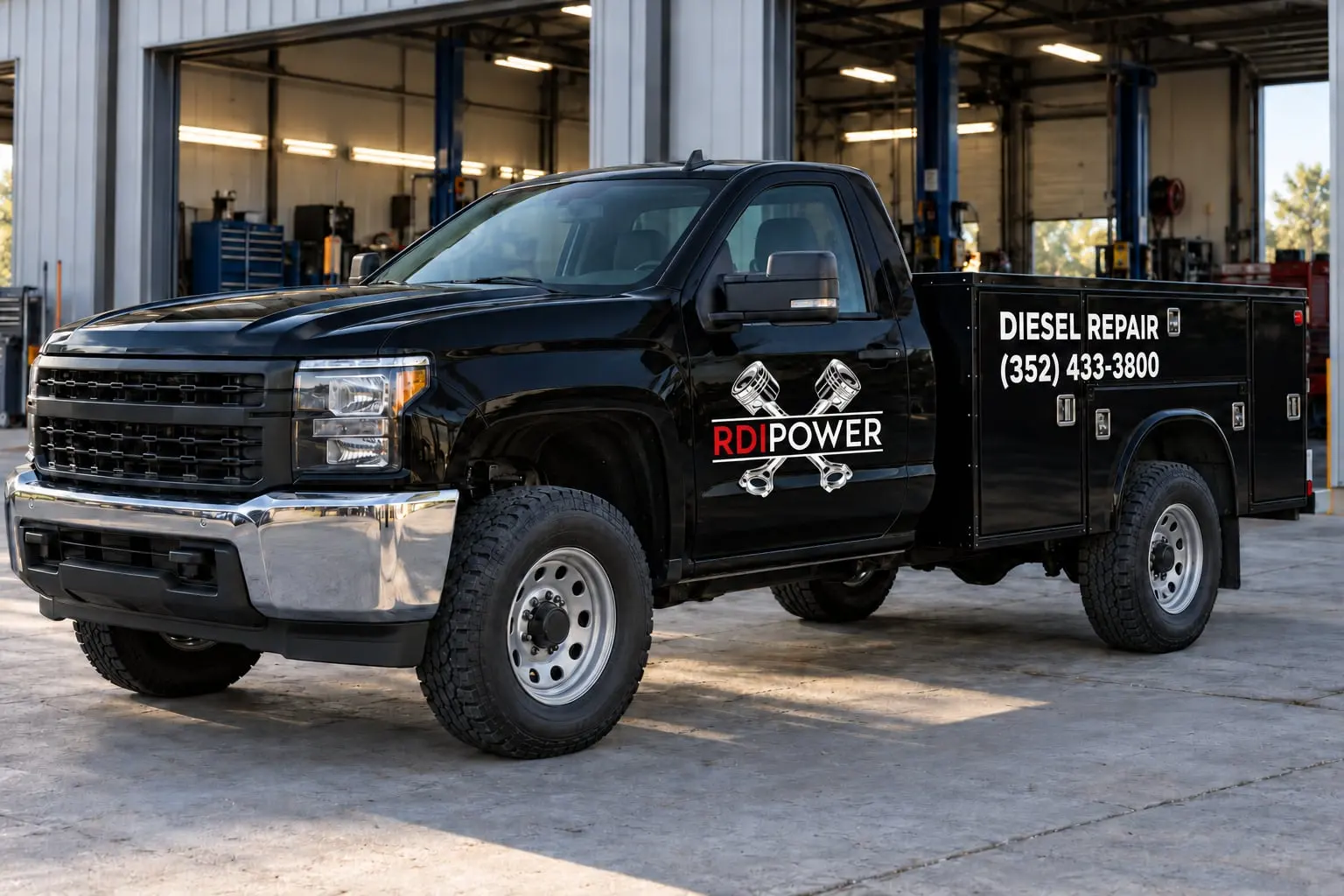
Port St. John grew fast: 12,267 people in 2010, 23,474 in 2020. It is an unincorporated Brevard County community between Titusville and Cocoa, and it sits close to 3 important truck routes: I-95, Challenger Memorial Parkway (SR 407) and the SR 528 Beachline, which links Orlando’s I-4 with Port Canaveral. RDI Power does not have a shop, office or anyone stationed in Port St. John. Our technicians come out from Brooksville with diagnostic software and repair equipment, and they work at yards, job sites and roadside stops when the location is safe.
I-95 beside Port St. John
FDOT’s 2025 counts show about 9,843 trucks a day on I-95 through or beside Port St. John, 19.3% of roughly 51,000 vehicles. That is close to 1 vehicle in 5. If your truck stops there, the most useful details are your direction, the nearest mile marker and whether you are north or south of the SR 528 interchange at Exit 205 near Cocoa. Move as far right as the shoulder allows, set out your triangles and wait away from the traffic side. The technician decides on arrival whether the shoulder is a safe place to work.
Challenger Memorial Parkway and the Beachline junction near Port St. John
SR 407 runs north from the I-95 and SR 528 interchange toward Kennedy Space Center and Titusville. It carries far less traffic than the interstate, about 10,300 vehicles a day, but trucks make up 20.1% of it, about 2,070 a day. On SR 407, your direction and the nearest crossroad or landmark are enough. If the truck stopped on a ramp at the SR 528 interchange, tell us which ramp; those are tight places to work, and moving the truck first may be the safer plan.
US 1 through Port St. John
US 1 carries about 1,274 trucks a day here, under 5% of its traffic. It is a local road with cross streets, businesses and driveways, so a truck that can still move a short distance should get off the main lanes before the technician arrives. The nearest cross street and a business name will put the technician on the spot. Space Coast Area Transit Route 11 serves Port St. John, so a nearby bus stop sign can also work as a reference point if nothing else is close.
On-site fixes in Port St. John
The technician’s first job is diagnosis, using Ford IDS on Power Stroke trucks, WiTECH on Ram and heavy-duty software on tractors and vocational trucks. What happens next depends on the complaint:
- It will not start. Batteries, cables, grounds and the starter get tested in turn. New batteries, a cleaned connection or a replacement starter often end the call.
- It will not go. A derate or shutdown is traced through codes and live data to a sensor, a wiring fault, a fuel filter or an aftertreatment problem, and many of those are repaired on site.
- It will not release. An air-brake truck that cannot build pressure has a leak somewhere; the line, fitting or chamber gets found and replaced.
- It is running hot. A failed belt, a split hose or a leaking fitting is replaced and the system refilled and checked.
Every job ends with a digital vehicle inspection, photos and notes included, so the record shows exactly what failed on the truck and what replaced it.
Port St. John trucks bound for Brooksville
Some repairs need a bay: internal engine work, transmission rebuilds and anything that requires a lift. When that is the diagnosis, we tell you on the spot and plan the trip to Brooksville with you, including timing and what it means for your schedule. The on-site findings go along. Labor carries a 3-year / 36,000-mile warranty; RDI Fleet repairs a 2-year / 24,000-mile warranty.
Getting a technician to Port St. John
Fleet customers have 24/7 roadside assistance. Everyone else can phone (352) 433-3800 while the shop is open, Monday through Friday from 7 in the morning to 4 in the afternoon.
For scheduled maintenance, see Port St. John fleet maintenance. Trucks that stop north of the community on SR 407 or US 1 are covered on our Titusville mobile diesel repair page, and the program as a whole is described under mobile diesel repair.