
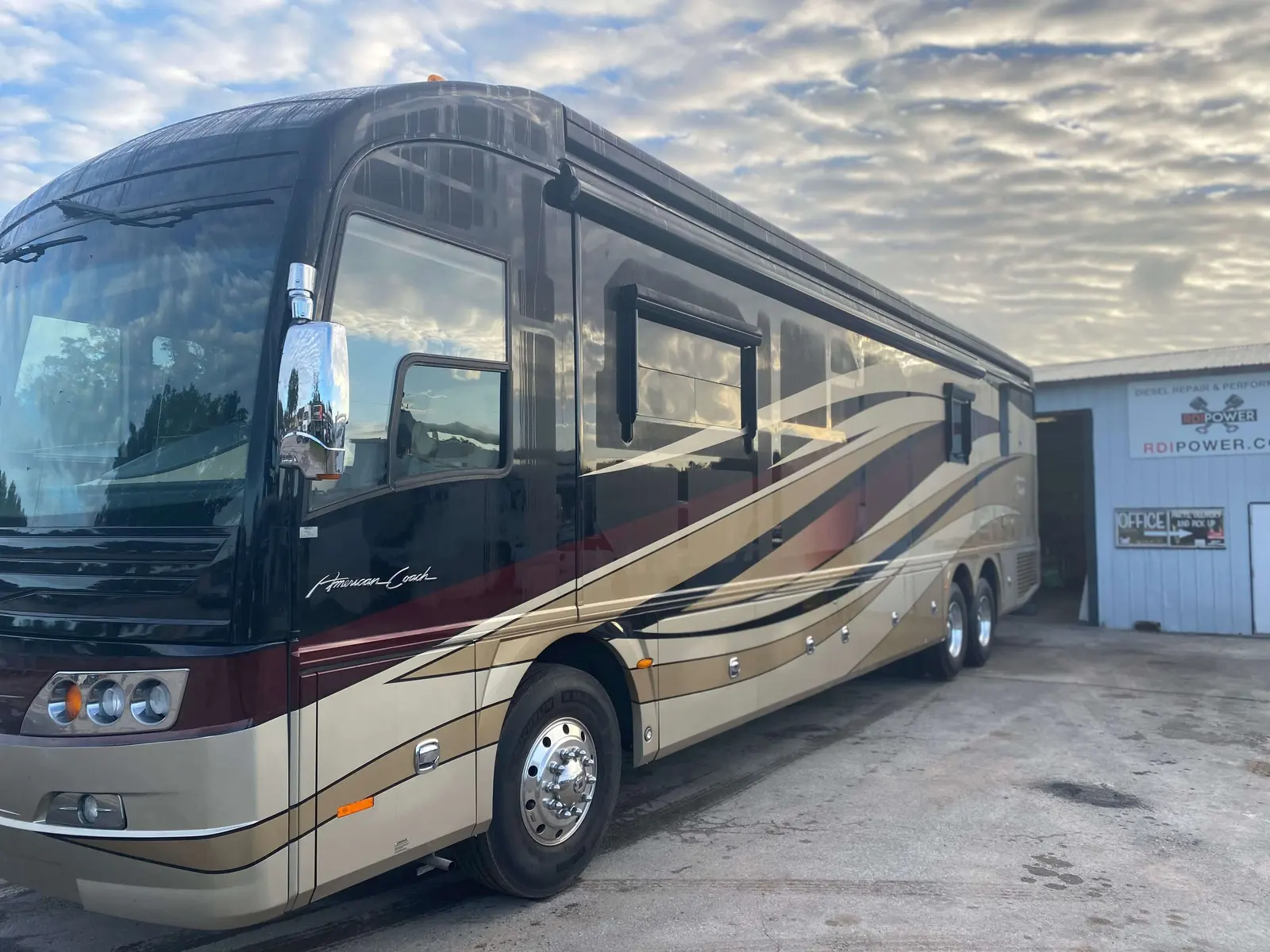
Under the living space, a diesel pusher is a heavy truck, and that truck is what RDI Power works on: the engine, the transmission, the air brakes, the suspension and the rest of the chassis. Floral City sits about 15 road miles from our Brooksville shop, and the Withlacoochee State Forest’s Citrus Tract, with its Holder Mine, Mutual Mine and Tillis Hill camping areas, lies just to the west. Whether your coach is parked at home base or at a campsite, here is how we handle it.
Pushers near Floral City and the Citrus Tract campgrounds
A coach that has sat for a few weeks, at a campsite or in storage, needs a different kind of attention than one that has been running steadily. Batteries drain, air systems bleed down, seals dry out and fuel can pick up water. Before a long drive, it pays to have a technician look at what sitting does to a pusher. If the coach is at one of the Citrus Tract campgrounds and will not start or will not build air, a mobile technician can diagnose it on site rather than pulling it out on a wrecker for a dead battery or a failed sensor.
Engine and Allison checks before leaving Floral City
The usual pusher drivetrain pairs a rear-mounted Cummins or Caterpillar diesel with an Allison automatic. Before a trip, the list we care about includes:
- Engine oil, fuel filters and the water separator, changed on schedule, with a look at what drains out
- Cooling: coolant age and level, every hose and belt, and a radiator buried at the back of the coach where debris builds up out of sight
- Charge air system: boost leaks at clamps and the charge air cooler, a common cause of black smoke and power loss on hills
- Allison: fluid level and condition, stored codes, and leaks at the cooler lines
- Warning lights and derates, traced to a cause before the trip, not after the first one
RDI Power is Caterpillar certified, and fuel injection work uses Alliant Power and Bosch diesel components.
Air brakes and air suspension on a coach heading down US-41
Air does 2 jobs on most pushers: it stops the coach and it carries it. When the gauges take longer than they used to to reach cut-out pressure, the compressor, a leak or the air dryer is usually behind it. A hiss with the engine off is a leak you can find with soapy water and patience, or we can find it for you. Brake chambers and slack adjusters get checked for stroke, and air bags for cracks and chafing. If the coach leans when parked or rides harder than it used to, the leveling valves and bags deserve a look.
Steering and the front axle matter just as much on a vehicle this heavy. If the front tires are wearing unevenly, our Floral City truck alignment page explains what the wear means.
Moving a disabled coach from Floral City
A healthy coach drives down US-41 into Brooksville, then over to Donto Way. A sick one should not. A coolant leak, a low-air warning or a transmission locked in a single gear can get much worse in 15 miles. Call (352) 433-3800 first. A disabled pusher needs a heavy wrecker, and the transmission has to be protected during the tow, usually by disconnecting the driveshaft or raising the drive axle off the road. Mention the rear engine and the coach length when you book the tow.
Every coach gets a digital inspection with photos and technician notes, and our labor carries 3 years or 36,000 miles of warranty coverage. Our RV service and repair page goes deeper on pusher work, and our long-distance RV maintenance checklist lists what owners can handle themselves before a trip. For coaches parked on the Inverness side of the Citrus Tract, see RV repair in Inverness Highlands South.