
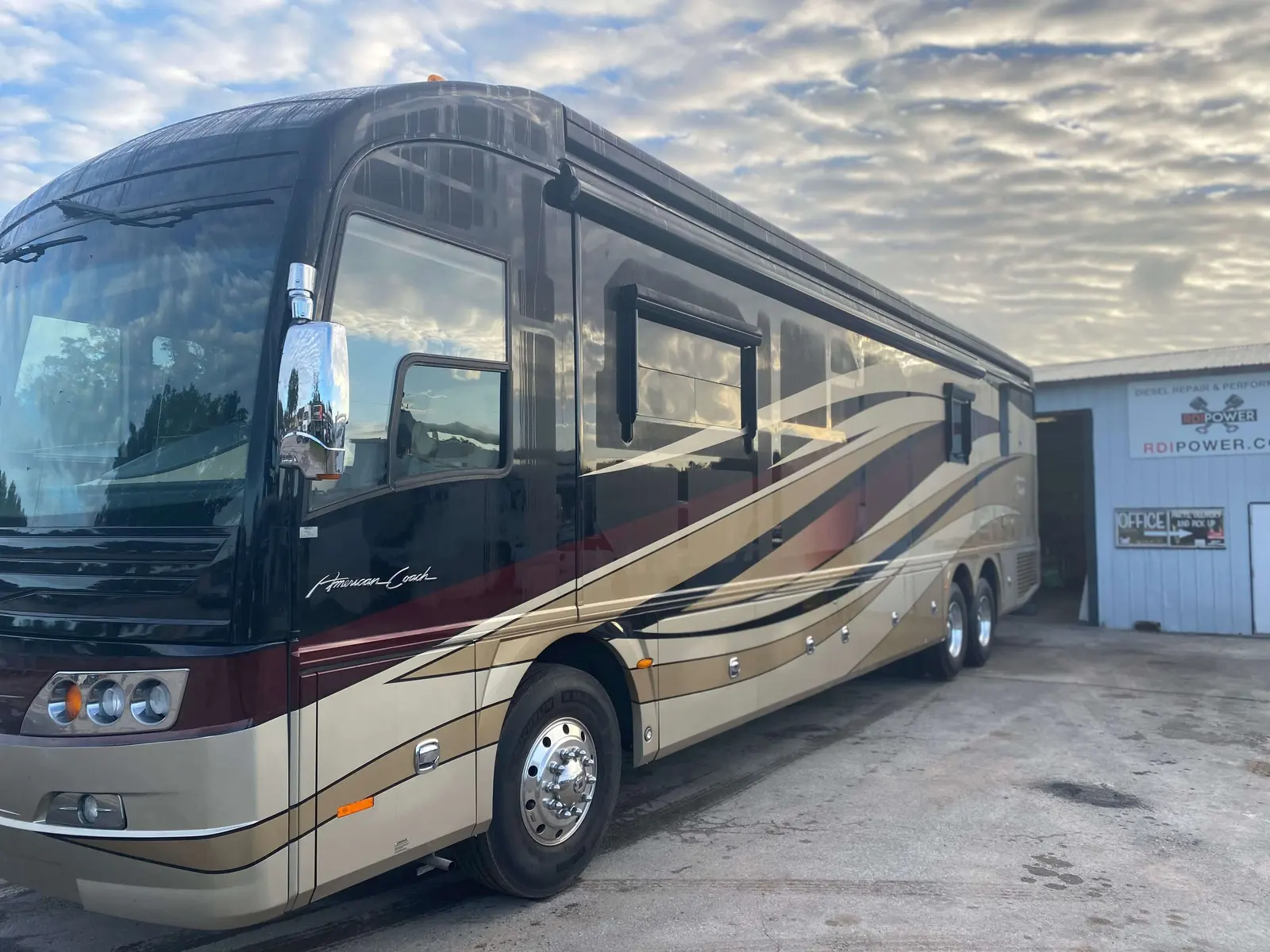
A diesel pusher is built on a heavy chassis, and the chassis is what RDI Power works on: engine, transmission, steering, suspension and air brakes. For Citrus Hills owners, the bays on Donto Way in Brooksville are about 34 road miles off, so we try to make each visit cover everything the coach needs before its next trip. This page focuses on the parts of a coach that decide how it drives: the steering, the axles and the tires, with the engine and Allison behind them.
Steering and front axles on Citrus Hills diesel pushers
A big coach steers through a power steering gearbox, a drag link, tie rods and kingpins on a solid front axle, and every one of those joints can develop play. Wear shows up as wander at highway speed, a steering wheel with slack before the coach responds, or a front tire wearing one edge. With the Suncoast Parkway now connecting at CR-486, just west of Citrus Hills, a coach can be at highway speed within minutes of leaving home, and that is where loose steering is least welcome.
We lift the front axle and check the kingpins, tie rod ends and drag link for movement, look at the gearbox for leaks and lash, and check the power steering fluid and pump. Worn parts get replaced before the alignment, and our Citrus Hills truck alignment page explains why the order matters.
Tag axles, tires and ride on a Citrus Hills coach
Many larger pushers ride on a tag axle behind the drive axle, usually on its own air bags. When the tag is not carrying its share, because of a leaking bag, a valve problem or low pressure, the drive axle and the tag tires both wear abnormally, and the coach can feel unsettled. Tag axle brakes and wheel bearings deserve the same attention as the others.
Tires age whether a coach is driven or not. Sun and heat crack sidewalls on a coach that sits outdoors, and tread depth says nothing about a 7-year-old tire’s internal condition. We read the date codes during an inspection and check for sidewall cracking, uneven wear and the shocks that keep the tires planted; our shocks page covers that side.
Engine and Allison service for Citrus Hills motorhomes
A typical pusher pairs a rear-mounted Cummins or Caterpillar with an Allison automatic. Before a season of travel, the engine needs oil and filters, fuel filters and the water separator, and a look at the cooling stack, where rear-mounted radiators and charge air coolers trap dust and grime. A coach that runs warm on long pulls often has nothing broken, just fins that cannot breathe. RDI Power is Caterpillar certified. On the Allison, fluid condition and level come first, then the stored codes, then a road test if something feels wrong.
The air brakes get a full check on every visit: build-up time, governor, dryer, leaks, chamber stroke and slack adjusters.
Planning the coach’s trip from Citrus Hills to Brooksville
The usual route runs Kensington Avenue to SR-44, the Parkway south, then US-98 and Cobb Road. Phone ahead so a bay long and tall enough for the coach is open when you arrive. Low air, leaking coolant or a transmission that is acting up are reasons not to gamble on 34 miles. A technician can often diagnose the coach at a campground or a safe roadside spot, and when the shop is unavoidable, we help line up a wrecker heavy enough for it.
Each coach gets a digital inspection with photos, and our labor on it carries the 3-year / 36,000-mile warranty. More on our motorhome work is on the RV service and repair page, and owners a few miles south can read about air suspension on our Lecanto RV repair page.