
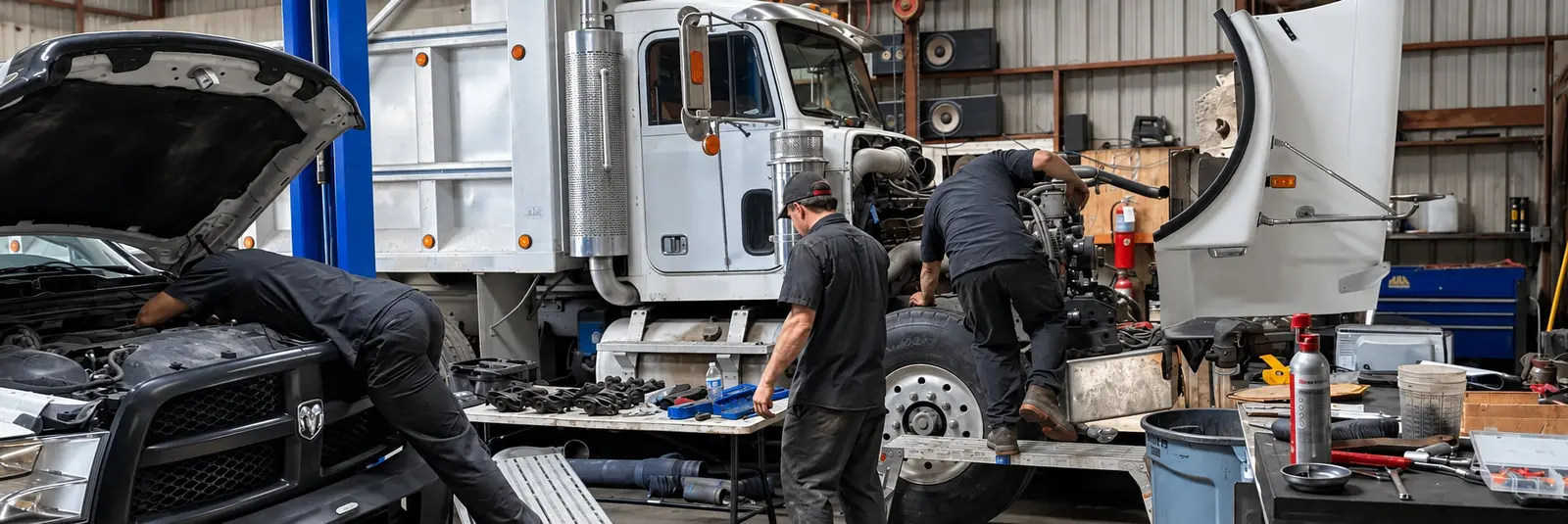
For a community known for its lake and fish camps, Lake Panasoffkee sits in the middle of some serious heavy-truck territory. I-75 crosses it at Exit 321, and CR-470 runs east from that interchange toward Sumterville and US-301, past a cement plant and limestone mine that load cement into trucks from silos. RDI Power repairs the Kenworth, Peterbilt, Freightliner, Mack, Volvo, International and Western Star tractors that run those roads, on site or in our heavy bays.
Cement tankers on the CR-470 corridor near Lake Panasoffkee
The Sumterville Cement Plant, at 4750 E. CR-470, runs a surface limestone mine and a clinker kiln rated at a nominal 1,186,250 tons a year, with trucks loading cement from silos and fuel arriving by truck and railcar. A truck that hauls bulk cement works a hard cycle: loaded starts, frequent brake applications and waiting time at a loadout.
If your tractor pulls a pneumatic tanker, the PTO and driveline that turn the blower add their own wear, and the engine runs for long stretches while the truck sits parked and unloading. Long idle periods keep exhaust temperatures down, so the particulate filter loads faster than it cleans and EGR parts collect soot. A derate in the middle of a run is often the first sign. We find out why the filter is loading, whether the cause is the duty cycle, a leaking injector, a boost leak or a failed sensor, before reaching for a forced regen as the fix.
I-75 Exit 321: Lake Panasoffkee’s heavy-truck door
Exit 321, where I-75 meets CR-470, is Lake Panasoffkee’s connection to the interstate. CR-475 comes up from Bushnell alongside the CSX line and ends here, and SR-44 to the south leads to the preserve entrance about 2 miles west of the interstate. A tractor that stops on I-75 near Exit 321 should get as far right as it safely can, with triangles out, and the driver should note the direction and mile marker before calling. A technician can handle many interstate failures on the shoulder or, better, on a safe pad off the ramp.
Dust, weight and brakes on Lake Pan haul routes
Cement and limestone dust is fine enough to find every gap. It loads air filters faster than a highway truck’s schedule assumes, packs the fins of radiators and charge air coolers until the engine runs hot, and gets into brake components, slack adjusters and electrical connectors. Loaded short-haul runs wear brake linings and drums quickly and work the compressor and air dryer hard. Trucks on those routes benefit from shorter filter intervals, regular cooling system cleaning and more frequent brake checks; our brake systems page covers the air brake side.
Getting a Lake Panasoffkee tractor serviced
The shop is about 34 road miles away, a big heavy tow for a truck that needs an air line or a sensor, so a mobile technician often goes first. When the job needs the bays, such as an overhaul, injector or turbocharger work, or aftertreatment repairs on a lift, the diagnosis is already done. Caterpillar certified technicians handle older Cat engines, the 3406 included, along with electronic Cummins, Detroit and Volvo engines, and trailers can be repaired during the same visit. Each truck leaves with a photo-documented digital inspection and a 3-year / 36,000-mile labor warranty, and fleet accounts have roadside coverage around the clock.
Fleets that run several units on these routes can see how RDI Fleet plans work on our Lake Panasoffkee fleet maintenance page. The full heavy scope is on our semi and heavy-duty truck repair page, and the Exit 314 side of the county is covered on Bushnell semi truck repair. Call (352) 433-3800 with the unit number and where it stopped.